



American Muscle Cars: Power, History, and the Cars That Defined an Era

America built a lot of cars in the 20th century. A specific group of them became something else entirely. American muscle cars were not just fast vehicles. They were a cultural statement, a product of postwar prosperity, a response to teenage rebellion, and the result of engineers who had the budget, the ambition, and the raw materials to build something genuinely extraordinary.
The golden era ran roughly from 1964 to 1973. During that decade, Ford, General Motors, and Chrysler competed aggressively for the performance of car buyers, each pushing displacement, horsepower, and styling further than the previous model year. The cars they produced during that period remain the benchmark against which everything else in American performance history gets measured.
This article covers the full story, from the origins of the muscle car concept through the golden era models that defined it, the decline that ended the first chapter, and the modern revival that brought the spirit back to showroom floors. Publications like Jalopnik have extensively covered the evolution of performance cars and automotive culture.
Table of Contents
- What Is an American Muscle Car
- The Origins: Before the Golden Era
- The Golden Era: 1964 to 1973
- Milestone Models of the Golden Era
- The Big Three and Their Rivalries
- Ford and the Mustang
- General Motors and the Camaro-GTO Rivalry
- Chrysler and the Mopar Legacy
- Most Wanted Classic Muscle Cars
- The Decline: 1973 to 1985
- The Modern Revival: 2005 to Present
- Modern Muscle Cars Compared
- Competitor Analysis: Ford vs Chevrolet vs Dodge
- Buying a Classic Muscle Car Today
- Classic Muscle Car Value Ranges by Condition
- Frequently Asked Questions
What Is an American Muscle Car
The definition has generated genuine debate among enthusiasts for decades, but most automotive historians agree on the core criteria. An American muscle car is a domestic, two-door vehicle built around a large displacement V8 engine, rear-wheel drive, and a relatively affordable price. The emphasis sits firmly on straight-line performance rather than cornering ability or refinement.
What separates a muscle car from a sports car is the approach. Sports cars achieve performance through light weight, balanced handling, and precision engineering. Muscle cars achieve it through displacement and torque. The formula is simpler and, in the hands of the right buyer, more immediately satisfying.
| Criteria | Muscle Car | Sports Car |
| Body style | Two-door, mid-size or full-size | Two-door, typically compact |
| Engine | Large V8, high displacement | Smaller, high-revving engine |
| Drive layout | Rear-wheel drive | Rear or all-wheel drive |
| Performance focus | Straight-line acceleration | Cornering and handling |
| Price point | Affordable, mass-market | Often premium or specialist |
| Origin | American domestic manufacturers | Various, often European |
The term muscle car entered common usage through American car magazines in the mid-1960s. Before that, the same cars appeared under names like supercar or performance car. The muscle car label stuck because it captured something specific about the character of these vehicles: raw, direct, and unapologetically powerful.
The Origins: Before the Golden Era
The muscle car did not appear from nowhere in 1964. The conditions that produced it developed through the 1950s as American manufacturers experimented with performance in ordinary passenger vehicles.
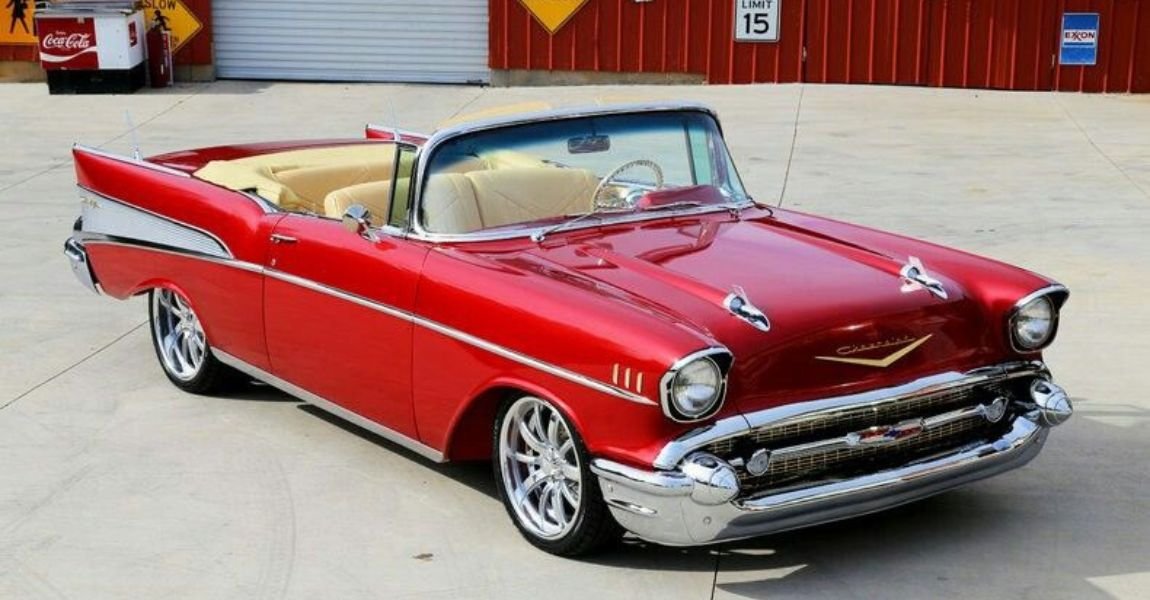
The 1949 Oldsmobile Rocket 88 earns frequent mention as a precursor. It combined a new overhead-valve V8 engine with a relatively lightweight body and demonstrated that a mainstream American car could be genuinely quick. The Chrysler 300 followed in 1955, offering a 300 horsepower engine in a production sedan and hitting 60 mph from standstill in around 9.8 seconds, remarkable for the era. Cars like the 1957 Chevrolet Bel Air also played a role in shaping early American performance culture.
The 1957 Rambler Rebel holds a significant place in the early history. American Motors Corporation offered it with a 327 cubic inch V8 producing 255 horsepower, making it the first mid-size car available with a big-block V8 engine. It covered 0 to 60 mph in 7.5 seconds, faster than any stock American sedan of the time except the fuel-injected Corvette.
These cars established the concept. The 1964 Pontiac GTO crystallized it into something the whole industry could follow.
The Golden Era: 1964 to 1973
General Motors had a corporate policy in 1963 prohibiting its divisions from installing engines larger than 330 cubic inches in mid-size cars. Pontiac engineers John DeLorean, Bill Collins, and Russ Gee circumvented this by offering the 389 cubic inch V8 as an option package on the Tempest rather than as a standalone model. They called it the GTO, borrowing the name from Ferrari.
The GTO sold 32,450 units in its first year against an internal forecast of 5,000. General Motors dropped the displacement restriction. Every manufacturer in Detroit took notice, and the muscle car era officially began.
Milestone Models of the Golden Era
| Car | Year | Engine | Horsepower | 0-60 mph |
| Pontiac GTO | 1964 | 389 cu in V8 | 325 – 348 hp | 6.6 sec |
| Ford Mustang Shelby GT350 | 1965 | 289 cu in V8 | 306 hp | 6.5 sec |
| Chevrolet Camaro Z/28 | 1967 | 302 cu in V8 | 290 hp | 6.3 sec |
| Dodge Charger R/T 440 | 1968 | 440 cu in V8 | 375 hp | 6.0 sec |
| Ford Mustang Boss 429 | 1969 | 429 cu in V8 | 375 hp | 6.0 sec |
| Plymouth Hemi ‘Cuda | 1970 | 426 cu in Hemi V8 | 425 hp | 5.6 sec |
| Chevrolet Chevelle SS 454 | 1970 | 454 cu in V8 LS6 | 450 hp | 5.4 sec |
| Dodge Challenger R/T | 1970 | 426 cu in Hemi V8 | 425 hp | 5.7 sec |
The 1970 model year stands as the peak of the golden era. Manufacturers pushed displacement and power to levels they would never reach again in the original era. The Chevrolet Chevelle SS 454 with the LS6 engine produced a factory-rated 450 horsepower, though many believe the actual figure exceeded that. The Plymouth Hemi ‘Cuda combined the 426 Hemi V8 with aggressive styling that still stops people in their tracks today.
The Big Three and Their Rivalries
The muscle car era produced its most intense drama through competition between Ford, General Motors, and Chrysler. Each had its own approach, its own engineering culture, and its own loyal buyer base.
These rivalries continue to be explored across platforms focused on car culture and reviews.
Ford and the Mustang
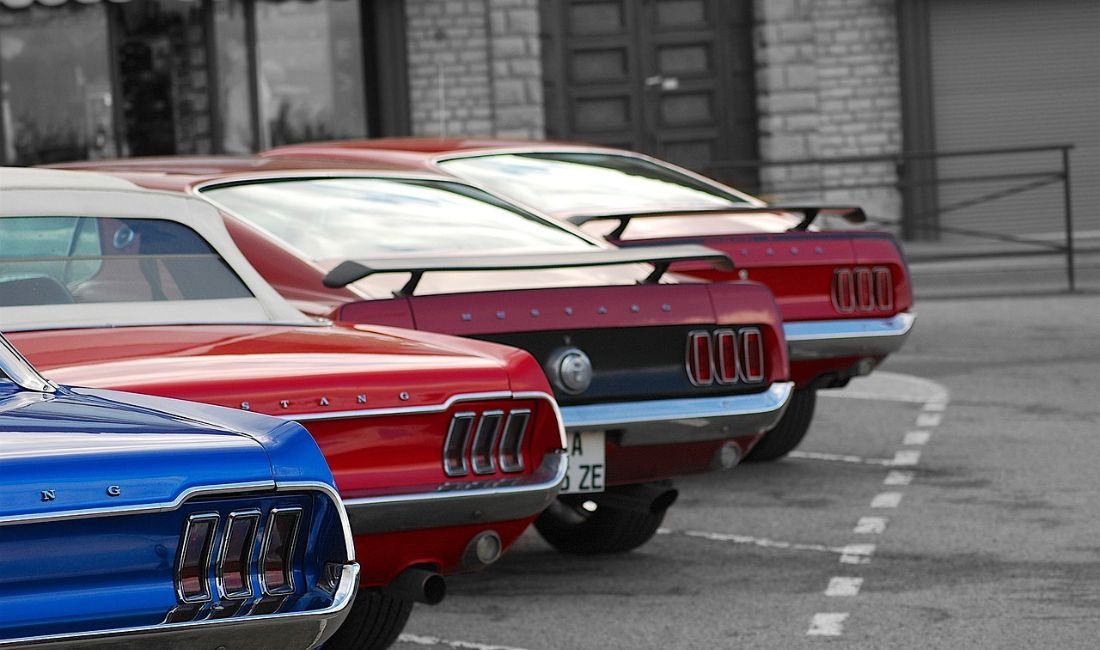
Ford introduced the Mustang in April 1964 at a base price of $2,368. It sold 22,000 units on its first day. The Mustang was technically a pony car rather than a pure muscle car in its base form, but the Shelby variants transformed it into something considerably more serious. The GT350 brought Carroll Shelby’s racing knowledge to a production car. The GT500 brought a 428 cubic inch engine and 360 horsepower. The Boss 429, built to homologate Ford’s racing engine, remains one of the most desirable Mustangs ever made.
General Motors and the Camaro-GTO Rivalry
General Motors fought the muscle car wars on multiple fronts simultaneously. Pontiac had the GTO. Chevrolet answered with the Camaro in 1967, directly targeting the Mustang. The Camaro Z/28, built for SCCA Trans-Am racing, used a high-revving 302 cubic inch V8 and became a benchmark for handling-focused muscle. The Chevelle SS grew into one of the most beloved body styles of the era. Buick contributed the GSX with its Stage 1 455 engine, rated at 360 horsepower but widely believed to produce considerably more.
Chrysler and the Mopar Legacy
Chrysler’s performance arm, known as Mopar, produced some of the most extreme muscle cars of the golden era. The 426 Hemi V8, introduced for racing in 1964 and made available in street cars from 1966, remains one of the most respected performance engines in American automotive history. Its hemispherical combustion chambers allowed exceptional airflow and produced 425 horsepower in street tune. Cars equipped with the Hemi, including the Dodge Charger, Dodge Challenger, Plymouth Barracuda, and Plymouth Road Runner, command the highest prices in today’s collector market.
Most Wanted Classic Muscle Cars
Collector demand concentrates on a specific group of models. Rarity, originality, and the presence of the most powerful engine options drive prices to levels that would have seemed impossible when these cars were new.
| Model | Most Sought Variant | Current Collector Value (USD) | Why Collectors Want It |
| Plymouth Hemi ‘Cuda Convertible | 1971, 426 Hemi | $2,000,000+ | Fewer than 15 built, rarest muscle car |
| Chevrolet Chevelle SS 454 LS6 | 1970, LS6 engine | $150,000 – $350,000 | Peak golden era power, 450 hp factory |
| Dodge Charger R/T | 1968-1969, 440 or Hemi | $80,000 – $200,000+ | Film history, iconic body, Hemi power |
| Ford Mustang Boss 429 | 1969 | $120,000 – $250,000 | Racing homologation, rare build numbers |
| Pontiac GTO Judge | 1969-1970, Ram Air IV | $80,000 – $180,000 | Original muscle car, Ram Air engines |
| Plymouth Road Runner | 1969 convertible | $90,000 – $200,000 | Only 2,200 convertibles built |
| Chevrolet Camaro ZL1 | 1969, all-aluminum 427 | $300,000 – $600,000+ | Only 69 built, rarest factory Camaro |
| Buick GSX Stage 1 | 1970, 455 Stage 1 | $80,000 – $150,000 | Underrated, genuine performance numbers |
Numbers-matching examples, meaning cars where the original engine, transmission, and major components still carry their factory-stamped identification numbers, sell for significant premiums over comparable cars with replaced components. Authenticity documentation through Protect-O-Plate cards, window stickers, and broadcast sheets adds further value.
The Decline: 1973 to 1985
Three forces combined to end the golden era between 1971 and 1974. Insurance companies began pricing high-performance cars as high-risk assets, making coverage for a teenager with a Hemi car genuinely unaffordable. The Clean Air Act of 1970 pushed manufacturers toward lower compression ratios to run on the unleaded fuel coming to market. Then the 1973 OPEC oil embargo arrived and made large displacement engines suddenly and dramatically unpopular.
Horsepower numbers collapsed. The 1971 Chevelle SS 454 LS5 produced 365 horsepower. The 1972 version of the same car produced 270. By 1975, most V8 engines in American cars produced between 140 and 170 horsepower. The cars got heavier as safety equipment added weight. Styling became blander. The muscle car as a concept essentially ceased to exist for most of the decade.
| Year | Chevelle SS 454 HP | Mustang V8 HP | Notes |
| 1970 | 450 hp (LS6) | 335 hp (Boss 302) | Peak golden era power |
| 1971 | 365 hp (LS5) | 285 hp | Compression drop begins |
| 1972 | 270 hp | 266 hp | Switch to net horsepower ratings |
| 1974 | 235 hp | 175 hp | Emissions regulations tighten |
| 1975 | Discontinued | 140 hp | SS 454 ends production |
The one exception to the malaise era gloom was the Pontiac Firebird Trans Am, which maintained a performance identity through the late 1970s when almost everything else had given up. The 1977 to 1981 Trans Am with the 6.6-litre engine kept the muscle car spirit alive during years when most manufacturers had abandoned it entirely.
The Modern Revival: 2005 to Present
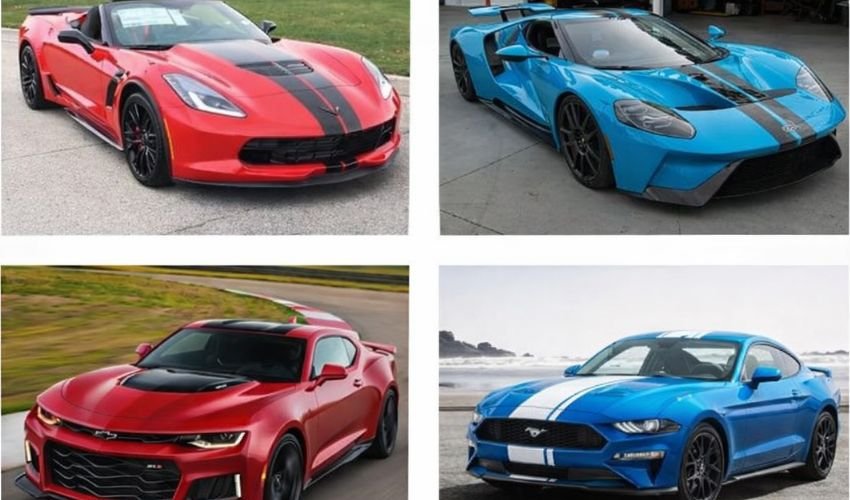
Ford restarted the conversation in 2005 with the fifth-generation Mustang. Retro styling pulled from the 1964 to 1966 design language combined with modern engineering to produce a car that looked backward while performing forward. The 2007 Shelby GT500 put a supercharged 5.4-litre V8 and 500 horsepower into the equation and demonstrated that the original formula still worked.
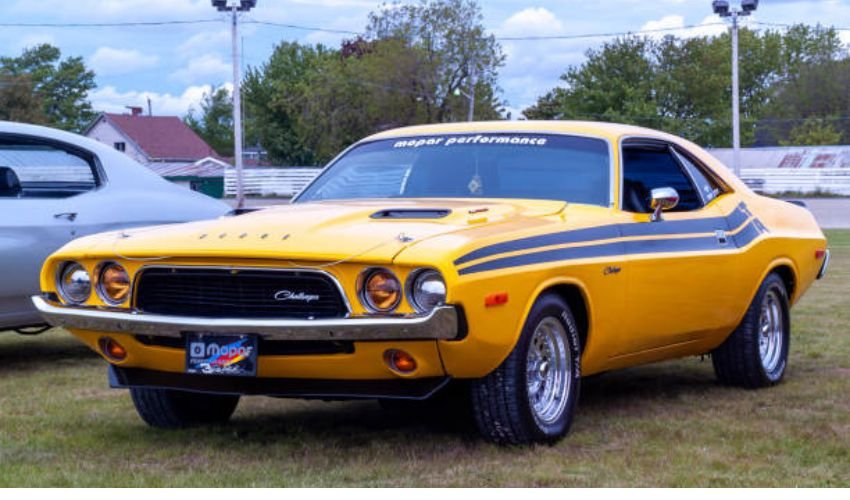
Dodge followed in 2008 with the new Challenger, the most direct retro design of the revival era. Based on the Chrysler 300 platform but styled to evoke the 1970 Challenger, it offered a choice of engines from a 250 horsepower V6 to the 425 horsepower Hemi V8. General Motors brought the Camaro back in 2010 after a four-year absence, offering a car that balanced classic proportions with genuinely competitive performance.
Modern Muscle Cars Compared
| Model | Engine | Power | 0-60 mph | Starting Price (USD) |
| Ford Mustang Shelby GT500 | 5.2L Supercharged V8 | 760 hp | 3.3 sec | $74,095 |
| Dodge Challenger SRT Hellcat | 6.2L Supercharged V8 | 717 hp | 3.6 sec | $61,495 |
| Dodge Challenger SRT Demon 170 | 6.2L Supercharged V8 | 1,025 hp | 1.66 sec | $96,666 |
| Chevrolet Camaro ZL1 | 6.2L Supercharged V8 | 650 hp | 3.5 sec | $71,000 |
| Ford Mustang Dark Horse | 5.0L V8 | 500 hp | 4.0 sec | $57,970 |
| Dodge Challenger R/T Scat Pack | 6.4L V8 | 485 hp | 4.2 sec | $44,495 |
The modern cars produce power figures that classic era engineers could not have imagined. The Dodge Challenger SRT Demon 170, built for 2023 as a final statement before the Challenger nameplate ended production, produced 1,025 horsepower from a supercharged 6.2-litre V8 on E85 fuel. That number exceeds the combined output of two golden era muscle cars.
Competitor Analysis: Ford vs Chevrolet vs Dodge
The modern muscle car market concentrates around three nameplate families that directly compete for the same buyer. Each takes a different approach to the core formula.
| Category | Ford Mustang | Chevrolet Camaro | Dodge Challenger |
| Heritage | 1964 to present | 1967 to 2024 | 1970 to 2023 |
| Body style | Fastback coupe / convertible | Coupe / convertible | 2-door coupe |
| Platform | S650 (2024) | Alpha (2016-2024) | LC (2008-2023) |
| Top engine | 5.2L Predator V8, 760 hp | 6.2L LT4 V8, 650 hp | 6.2L Hellephant V8, 1,025 hp |
| Rear seat usability | Functional | Very limited | Best in class |
| Daily drivability | High | Moderate | High |
| Handling focus | High, IRS standard | Highest, track-focused | Moderate, comfort-biased |
| Collector potential | High (Shelby variants) | Moderate | High (Hellcat/Demon era) |
| Production status (2025) | Active | Discontinued 2024 | Discontinued 2023 |
The Camaro’s discontinuation after the 2024 model year removes Chevrolet from the active muscle car market for the first time since 1967. General Motors cited weak sales relative to development costs. The decision generated significant controversy among enthusiasts and leaves Ford’s Mustang as the only continuously produced nameplate from the original golden era.
Dodge retired both the Challenger and Charger for 2024, replacing them with electrified versions under the Charger name. The last internal combustion Challenger, the Demon 170, sold out immediately and already trades at significant premiums over its original sticker price. Whether the electric successors carry the muscle car identity forward or represent a fundamental break with the concept remains genuinely contested.
This shift also reflects the growing importance of the future of electric cars in the global automotive industry.
Buying a Classic Muscle Car Today
The classic muscle car market rewards buyers who do thorough research before committing. Values have risen significantly over the past decade, which means the cost of buying a poor example has also increased. A properly used car buying guide can help avoid costly mistakes when entering this market.
Numbers matching matters most. The presence of the original engine block with matching VIN stamps, original transmission, and original rear axle determines value more than any other single factor. A documented numbers-matching car sells for two to three times the price of an equivalent car with replacement components.
Classic Muscle Car Value Ranges by Condition
| Model | Project (USD) | Driver Quality (USD) | Excellent (USD) |
| 1969 Camaro Z/28 | $15,000 – $30,000 | $45,000 – $80,000 | $100,000 – $180,000 |
| 1970 Chevelle SS 454 | $20,000 – $40,000 | $60,000 – $100,000 | $150,000 – $350,000 |
| 1969 Dodge Charger R/T | $18,000 – $35,000 | $55,000 – $90,000 | $100,000 – $220,000 |
| 1970 Plymouth ‘Cuda 440 | $25,000 – $50,000 | $80,000 – $130,000 | $200,000 – $400,000 |
| 1969 Ford Mustang Boss 429 | $30,000 – $55,000 | $90,000 – $150,000 | $180,000 – $280,000 |
| 1970 Pontiac GTO Judge | $15,000 – $28,000 | $40,000 – $75,000 | $90,000 – $180,000 |
Rust remains the primary concern on any survivor. Focus inspections on the floor pans, frame rails, trunk floor, and lower rear quarter panels. Structural rust on a muscle car body requires expensive specialist fabrication. Surface rust on replaceable panels is manageable.
Verify engine authenticity through the pad stamp on the front of the block, which should match the last eight digits of the VIN. The transmission and rear axle carry their own date codes that should precede the vehicle build date. A professional pre-purchase inspection from a specialist familiar with the specific make is worth every dollar at these price points.
Even small components like an electric fan for cars can affect engine cooling and long-term reliability.
Frequently Asked Questions
What was the first American muscle car?
The 1964 Pontiac GTO holds the widest recognition as the first true muscle car. Pontiac engineers installed a 389 cubic inch V8 into the mid-size Tempest as an option package, bypassing General Motors’ displacement restrictions. It sold nearly 32,500 units in its first year against an internal forecast of 5,000, proving the market existed and triggering the golden era. Earlier cars like the 1957 Rambler Rebel and the 1949 Oldsmobile Rocket 88 shared some muscle car characteristics, but the GTO established the formula that the entire industry followed.
What ended the muscle car golden era?
Three forces worked together to end the era. Insurance companies began classifying high-performance cars as high-risk and charging premiums that made them unaffordable for young buyers. The Clean Air Act of 1970 forced manufacturers to lower compression ratios to run on unleaded fuel, which reduced power significantly. The 1973 OPEC oil embargo made large displacement engines economically and socially unacceptable almost overnight. By 1974, most manufacturers had either discontinued their high-performance models or detuned them to the point of irrelevance.
What is the rarest American muscle car?
The 1971 Plymouth Hemi ‘Cuda Convertible stands at the top of the rarity list. Fewer than 15 examples left the factory with the 426 Hemi engine and open-top body. When authenticated examples appear at auction, they regularly sell for two million dollars or more. The 1969 Chevrolet Camaro ZL1 follows closely with only 69 produced, using an all-aluminum 427 cubic inch engine originally developed for Can-Am racing.
How do modern muscle cars compare to the originals?
Modern muscle cars produce more power, stop faster, handle better, and offer safety features the originals never had. A 2023 Ford Mustang Shelby GT500 produces 760 horsepower and runs 0 to 60 mph in 3.3 seconds, numbers that would have seemed impossible from a factory car in 1970. What modern cars cannot replicate is the mechanical simplicity, the analog character, and the cultural context of the golden era cars. Both have genuine merit and appeal to different buyers for different reasons.
Are muscle cars a good investment?
Numbers-matching examples of the most desirable models have appreciated steadily over the past two decades. A 1970 Chevelle SS 454 LS6 that sold for $40,000 in 2005 now sells for $200,000 to $350,000 in comparable condition. However, not every muscle car appreciates equally. Common models in average condition hold value but do not appreciate dramatically. The best investment results come from buying the most authentic, best-documented examples of the most desirable variants, which requires significant upfront capital. Buying a muscle car purely as a financial investment carries risk. Buying one because you genuinely want to own and enjoy it tends to produce better outcomes.
Which modern muscle car should I buy?
The Ford Mustang remains the only continuously produced nameplate from the original golden era, which gives it a historical continuity that the Camaro and Challenger no longer offer. The Shelby GT500 represents the peak of modern Mustang performance. The Dodge Challenger Hellcat and Demon variants, now discontinued, already trade at premiums over their original prices and will likely continue to appreciate as the last internal combustion examples. The Chevrolet Camaro ZL1, also now discontinued, offers track-focused performance at prices that still make sense relative to its capabilities.


3 Comments
[…] step matters even more for high-value transactions. If you are buying something like a classic muscle car or high-value vehicle, identity verification before the meeting is not optional. The more expensive the vehicle, the more […]
[…] term ‘jalopy’ holds a special place in automotive language, especially in American car culture. It instantly brings to mind an old, worn-out vehicle that still manages to run despite its […]
[…] in the make-specific guides (Toyota, Dodge, Ford trucks) get more targeted value and similar performance-focused vehicles. Those articles address real failure patterns on real vehicles rather than generic car […]
Comments are closed.