
Bagnaia: The Full Story of MotoGP’s

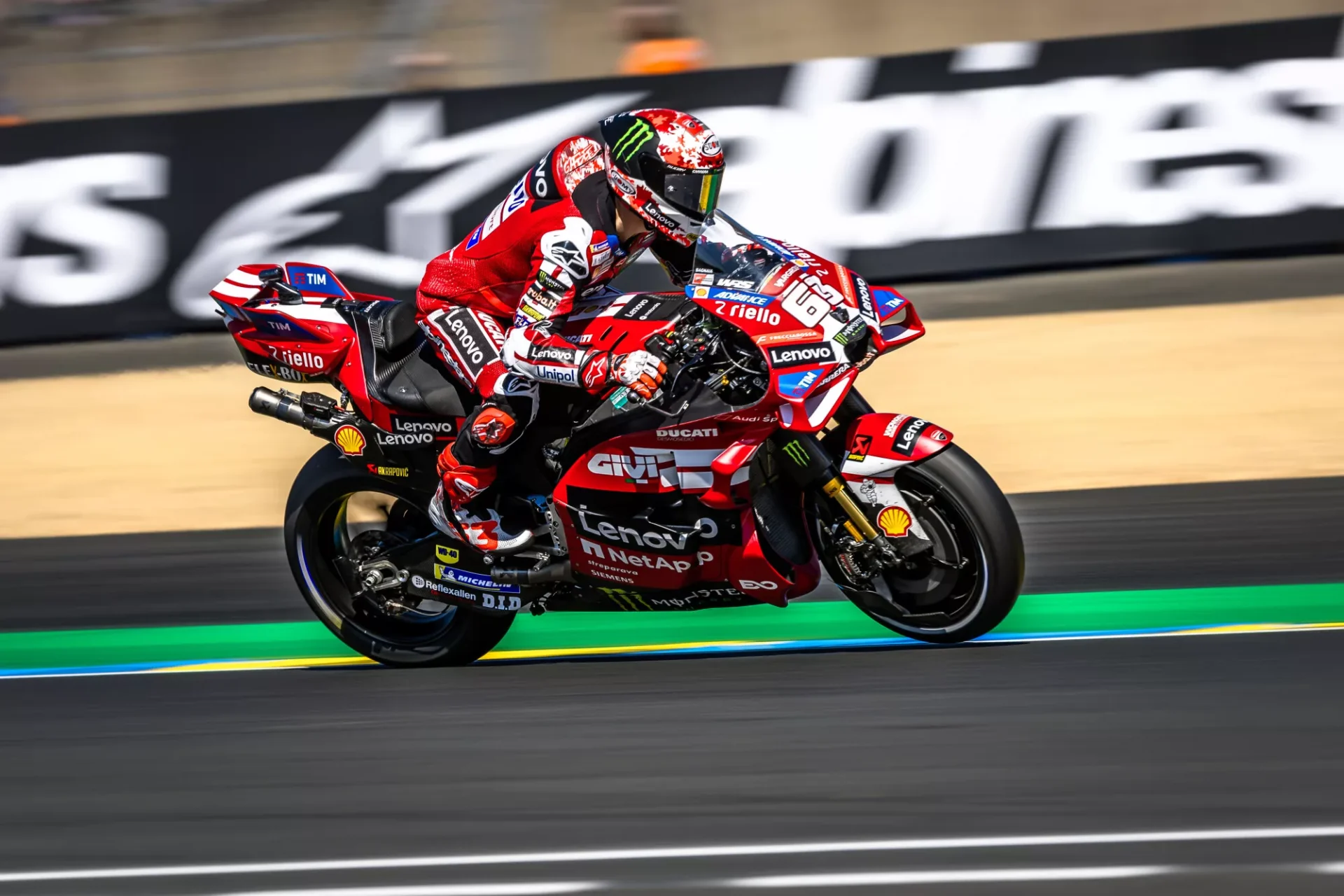
Francesco Bagnaia did not grow up as a household name. He came through Valentino Rossi’s VR46 Academy as a quiet, technically-minded kid from Turin, spent years grinding through Moto3 without winning a title, and only truly broke through in Moto2 in 2018. By 2022, he was a MotoGP World Champion. By 2023, he was a back-to-back champion. Then 2025 happened, and the story got complicated.
Pecco Bagnaia represents something specific in MotoGP: the methodical, technically precise rider who wins by reading the bike perfectly and maximising exit speed. He is not a natural wheel-spinner or a risk-taker in the Marc Marquez mould. He rides the front end hard, carries corner speed, and trusts his engineers to give him a bike that matches that style. When the relationship between rider and machine works, he looks almost unbeatable. When it does not, as 2025 showed, he can look almost ordinary.
This article covers everything about Bagnaia: the full career, the key seasons, the technical reality of how and why he races the way he does, and where things stand heading into 2026.
A Brief History
Francesco Bagnaia was born on January 14, 1997, in Turin, in the Piedmont region of northern Italy. He started riding minimotos as a young child, which is how almost every Italian MotoGP rider’s story begins. What set him apart early was his technical feedback, even as a junior rider. He joined Valentino Rossi’s VR46 Riders Academy while still in the junior categories, a programme that has become one of the most effective talent pipelines in motorcycle racing.
His pre-GP career moved through the Italian and Spanish junior championships. In 2009, he won the European MiniGP championship. By 2011, he was racing in the Spanish 125cc series. He earned a full Moto3 World Championship seat in 2013 with Team Italia FMI. That first season was hard: he failed to score a single point in 14 races. It was a rough start that would have ended a lesser rider’s momentum, but he kept developing.
He spent four seasons in Moto3, eventually settling with the Aspar Mahindra team in 2015 and 2016. His first Grand Prix win came at Assen in 2016, followed by another in Malaysia that same season. He finished 2016 fourth in the Moto3 standings with 145 points, 2 wins, and 6 podiums, enough to earn promotion to Moto2.
The jump to Moto2 in 2017 confirmed what the VR46 team already knew. He finished fifth in his debut Moto2 season, earned Rookie of the Year honours, and banked four podiums. In 2018, riding for the Sky Racing Team VR46, he dominated the season. Eight wins, twelve podiums, and the 2018 Moto2 World Championship title, sealed in Malaysia. He was 21 years old. Ducati had seen enough and placed him at the satellite Pramac team for 2019.
Career Generations: From Moto3 to MotoGP Factory Rider
| Season | Class | Team | Result | Key Stat |
| 2013 | Moto3 | Team Italia FMI | 26th | 0 points scored |
| 2014 | Moto3 | Sky VR46 | 9th | 5 top-10s in first 7 races |
| 2015 | Moto3 | Aspar Mahindra | 9th | First podium at Le Mans |
| 2016 | Moto3 | Aspar Mahindra | 4th | 2 wins, 145 points |
| 2017 | Moto2 | Sky VR46 | 5th | Rookie of Year, 4 podiums |
| 2018 | Moto2 | Sky VR46 | Champion | 8 wins, 12 podiums |
| 2019 | MotoGP | Pramac Ducati | 11th | MotoGP debut season |
| 2020 | MotoGP | Pramac Ducati | 7th | First MotoGP podium (Misano) |
| 2021 | MotoGP | Ducati Lenovo | 2nd | First MotoGP wins, 4 victories |
| 2022 | MotoGP | Ducati Lenovo | Champion | 7 wins, overcome 91-point deficit |
| 2023 | MotoGP | Ducati Lenovo | Champion | 7 wins, overcome 91-point deficit |
| 2024 | MotoGP | Ducati Lenovo | 2nd | 7 wins, overcome 91-point deficit |
What Made Him Different
Bagnaia’s riding style is front-end biased in a very specific way. He carries speed into corners using heavy front brake pressure, then transitions onto the throttle earlier than most riders. His fastest laps often come from corner entry speed and exit drive rather than raw top speed down the straight. In Ducati’s case, this suited the Desmosedici perfectly from 2021 through 2024, because the bike’s aerodynamic package and chassis balance allowed strong front braking while keeping the bike settled.
Where he differs most obviously from Marquez is in how he handles the rear of the bike. Bagnaia wants a stable, planted rear during entry and mid-corner. Marquez, by contrast, regularly saves slides and uses controlled rear instability as a steering tool. This difference in style became the central story of the 2025 season, when Ducati built the GP25 in a direction that suited Marquez’s aggressive style and left Bagnaia struggling to adapt.
His corner entry approach requires high confidence in front-end feedback. When the front of the bike communicates clearly, Bagnaia is one of the fastest riders on the grid at braking late and turning in aggressively. When that feedback is absent or unpredictable, he backs off, his lap times suffer, and his confidence compounds downward quickly. This is not a weakness exactly; it is the flip side of being an extremely technically driven rider. Every analyst who knows the paddock well, including former riders who now comment on the sport, has noted this trait consistently.
His VR46 Academy background also matters. The academy does not just train riders physically; it trains them technically. Valentino Rossi’s philosophy always centred on understanding the bike deeply, communicating precisely with engineers, and building setups over sessions rather than relying on natural talent to mask mechanical problems. Bagnaia absorbed that philosophy completely and became one of the most articulate technical communicators in the paddock.
What It Is Like to Race Against Bagnaia
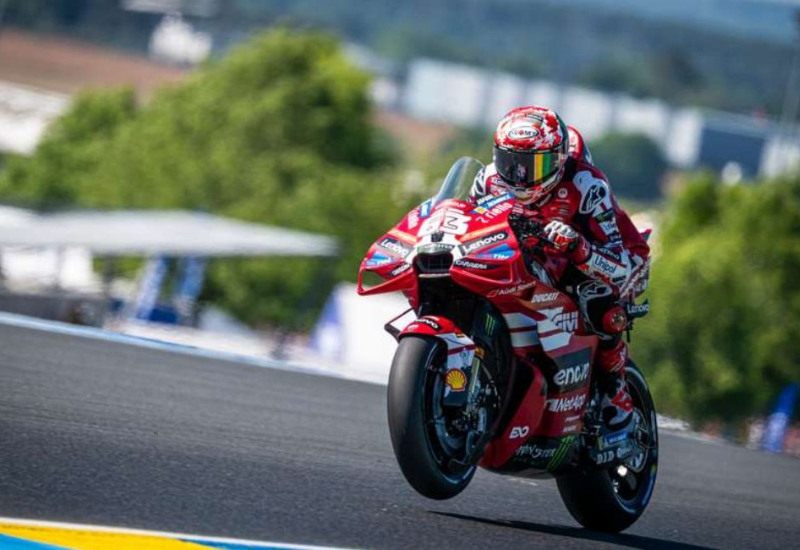
Riders who have shared the front of the grid with Bagnaia in his peak years describe a specific challenge: he rarely makes mistakes in clean air. During his 2023 and 2024 title-winning seasons, he combined qualifying pace with race pace at a level very few MotoGP riders have ever managed. His pole position laps are built on the same principles as his race laps, he does not change his style dramatically between single-lap attacks and 20-lap races.
His braking zones are one of his sharpest weapons. He can brake later than most riders into slower corners while keeping the bike on line, because he trusts the front end completely during his periods of good form. Jorge Martin, who pushed him hardest through 2024 before losing the title by 10 points in the final race, described Bagnaia in his peak as extremely difficult to catch on fast circuits where high-speed corners demand precision over aggression.
The 2022 season remains the most discussed evidence of his mental strength. He was 91 points behind Fabio Quartararo heading into the second half of the season, which was the largest deficit any rider had ever overcome to win the MotoGP title. He did it by winning four consecutive races: Assen, Silverstone, Austria, and Misano. He did not change his approach. He kept riding his style, kept working methodically with his engineers, and let the points come back to him. He clinched the title with a ninth-place finish in Valencia, needing nothing more, and took it anyway.
For anyone who wants to understand how motorsport journalism and analysis approaches riders like Bagnaia, the Jalopnik about page gives good context on what serious automotive coverage looks like when it prioritises accuracy and depth over headlines.
The 2025 Season: What Went Wrong
The 2025 season was Bagnaia’s worst in four years, and the reasons were both technical and psychological. Ducati brought Marc Marquez into the factory team alongside Bagnaia, creating the most discussed teammate pairing in MotoGP history. What followed exposed a direct conflict between two fundamentally different riding styles, and the bike Ducati built for 2025 suited Marquez’s style far better.
Bagnaia explained it publicly and with unusual honesty. The GP25 required understeer tolerance and strong rear-slide management, which is exactly what Marquez excels at. Bagnaia needs a firm, communicative front end with stable rear behaviour. Ducati modified the engine and weight distribution of the GP25 in ways that moved the bike away from what Bagnaia had used so successfully in 2022, 2023, and 2024. He described it clearly: “I need a firm motorcycle at the front. I often ride it with the front. Marc, on the other hand, prefers a bike with very pronounced understeer.”
The results reflected the mismatch. Marquez won the 2025 title with 545 points and 11 victories. Bagnaia finished fifth with 288 points and just 2 wins. His low point came in the final stretch of the season, where he failed to score points in five consecutive Grands Prix. For context, his best recent result before that run had been a dominant double at Motegi in Japan, where he beat Marquez by four seconds. The contrast between that performance and what followed showed how volatile his season-long form had become.
A post-race test at Misano, where he briefly rode the 2024-spec GP24, reportedly unlocked his Motegi form by reminding both him and his engineers what the bike setup should feel like. Ducati’s technical chief Gigi Dall’Igna later confirmed that a ride height device change on the GP25 had affected front-end feel in ways that particularly hurt Bagnaia’s style.
Some observers pointed to a psychological dimension. Former KTM team principal Hervé Poncharal argued that much of Bagnaia’s 2025 difficulty had a mental component, describing a confidence spiral created by direct daily comparison with one of the most dominant riders in the sport’s history. Racing analysis, much like the detailed technical reviews on Jalopnik, requires separating physical symptoms from underlying causes, and in Bagnaia’s case, the technical and psychological factors reinforced each other in a negative loop.
2026 and Beyond {#2026-and-beyond}
The 2026 season matters enormously for Bagnaia. His contract with Ducati runs through the end of 2026, and the manufacturer’s priority for 2027 contracts currently sits with retaining Marc Marquez. Reports from early 2026 indicate Ducati has shown interest in Pedro Acosta for a 2027 seat, which would effectively displace Bagnaia unless he forces a rethink through results.
Ducati team principal Davide Tardozzi said publicly in early 2026 that he expects “the 2024 version” of Bagnaia to return, citing the GP26 machine as better suited to Bagnaia’s style than the GP25. Bagnaia himself confirmed during winter testing that the GP26 feels like an improvement, saying it has “different DNA” but is better for his riding style. He finished the Buriram pre-season test fourth overall, which represented a significant step from his 2025 form.
The 2026 Thai Grand Prix, the season opener, told a more complicated story. Bagnaia finished ninth, describing tire spin issues and acknowledging that “other Ducati riders were more competitive than me.” Marquez, meanwhile, suffered a rear tire puncture, ending his race early. The season is early, but the pattern of Bagnaia needing more time to optimise his setup than his teammate remained visible.
What is clear is that Bagnaia at his best is one of the most complete MotoGP riders of the modern era. His 2022 comeback, his 2023 title defence, and his 2024 campaign of 11 wins all prove that. The question for 2026 is whether the combination of a better-suited machine and a full winter reset gives him what he needs to reclaim the form that made him a two-time champion.
FAQs
Who is Francesco Bagnaia, and why is he called ‘Pecco’?
Francesco Bagnaia is a professional motorcycle racer from Turin, Italy, born January 14, 1997. He competes in MotoGP for the Ducati Lenovo Team under the number 63. His nickname, Pecco, is an old Piedmontese diminutive of Francesco that his family used since childhood. He is a two-time MotoGP World Champion (2022 and 2023) and the 2018 Moto2 World Champion, making him a three-time world champion overall. He is the most successful Italian rider in the premier class since Valentino Rossi.
How did Bagnaia win the 2022 MotoGP championship?
The 2022 season is defined by the largest points deficit ever overcome to win the MotoGP title. After the German Grand Prix at the Sachsenring, Bagnaia was 91 points behind Fabio Quartararo despite already winning races earlier in the season. He responded by winning four consecutive Grands Prix at Assen, Silverstone, the Red Bull Ring in Austria, and Misano. He took the championship lead at Phillip Island in Australia and clinched the title with a ninth-place finish at the season finale in Valencia. He won the championship by 17 points over Quartararo.
What went wrong for Pecco Bagnaia in 2025?
The short answer is that the 2025 Ducati GP25 was not built for his riding style. Ducati modified the bike’s weight distribution and ride height device settings in ways that reduced front-end feel and increased rear instability under braking. Bagnaia relies on a firm, communicative front end to ride aggressively into corners. The GP25 suited Marc Marquez, who prefers understeer and rear-slide control, far better. The result was a season where Bagnaia finished fifth in the championship with 288 points against Marquez’s title-winning 545.
Is Bagnaia better than Marc Marquez?
This is a genuinely contested question with no clean answer. Marquez has seven MotoGP titles compared to Bagnaia’s two. Marquez is arguably more adaptable across different bike conditions. Bagnaia, when the bike fits his style, produces cleaner, more consistent lap times over a race distance and makes fewer high-side errors. In 2024, when both were on competitive bikes, Bagnaia won 11 races to Marquez’s 8 (when Marquez was on the factory Ducati only from Valencia onward). Over a full season on equal machinery, the 2026 season will offer the first genuine head-to-head comparison.
What is Bagnaia’s racing number and why?
Bagnaia races under number 63. In MotoGP, a rider chooses a permanent number when they enter the World Championship. Number 63 has been Bagnaia’s throughout his Grand Prix career. When a rider wins the MotoGP World Championship, they have the option to race the following season with the number 1 on their bike. Bagnaia chose to do this in 2023 after winning the 2022 title and successfully defended his championship that year, making him the first rider since Mick Doohan in the 1990s to successfully defend the number 1 plate.
What is Bagnaia’s future with Ducati beyond 2026?
His current contract runs through the end of the 2026 season. Ducati’s priority for 2027 contracts appears to be retaining Marc Marquez, whose dominant 2025 performance made him the cornerstone of their programme. Reports from late 2025 suggested that Pedro Acosta is in a strong position to take a factory Ducati seat for 2027, which would directly affect Bagnaia’s position. Ducati has stopped short of confirming any 2027 plans, and Bagnaia’s performance in the 2026 season will almost certainly determine whether he stays in red or has to make a significant change.
Which championships has Francesco Bagnaia won?
Bagnaia has won three World Championships in total. His first came in 2018 in the Moto2 class, where he dominated the season with eight wins riding for the Sky Racing Team VR46. His second and third championships came in MotoGP in 2022 and 2023, both with the factory Ducati Lenovo Team. The 2022 title was Ducati’s first MotoGP Riders’ Championship since Casey Stoner won for them in 2007. The 2023 title made him the first rider to defend the MotoGP championship since Jorge Lorenzo in 2010 and 2012.
Conclusion
Bagnaia’s career is still unfinished, and the most interesting chapter might be the one being written right now. His 2022 and 2023 performances put him among the best MotoGP champions of the modern era. His 2024 season, 11 wins despite losing the title to Martin on consistency, showed he can operate at an extraordinary level even when things go partially against him.
The 2025 season showed his limits in a different way. He is not the kind of rider who adapts his fundamental style to a different machine quickly. When the bike fits, he looks almost perfect. When it does not, he struggles to improvise. Whether that is a weakness or simply the cost of being an extremely specialised type of rider depends on your perspective, but it is an honest assessment of what the data shows.
The 2026 season sets up as the most important of his career. A Ducati that better matches his front-end riding style, a full winter to reset mentally, and the pressure of a contract year all combine to create either a strong comeback or an exit. Based on everything he has shown from 2021 through 2024, underestimating Pecco Bagnaia has historically been a mistake.