
Inside the Datsun 240Z Interior: A Full Guide

Introduction
When Datsun rolled out the 240Z for the 1970 model year at a base price of $3,526, the automotive world expected another modest Japanese economy play. What buyers found when they opened the door was something very different: a purposeful two-seat cockpit that drew direct comparisons to European grand tourers costing twice as much. The car weighed just 2,238 pounds and carried a 2.4-liter inline-six producing 150 horsepower, but its interior told a story that the raw specs alone could not.
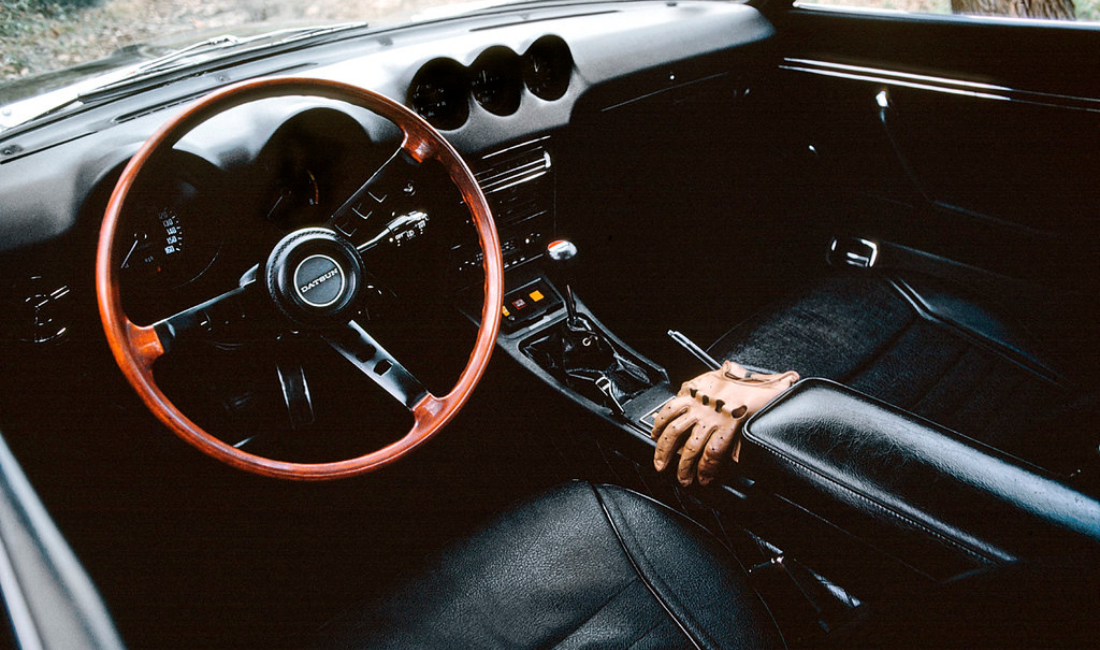
The datsun 240z interior succeeded because it treated every detail as intentional. Two large primary gauges dominated the driver’s sightline, a genuine wood shift knob sat where your left hand naturally fell, and reclining bucket seats wrapped both occupants in a snug, driver-focused layout that felt far more sophisticated than the sticker price suggested. Period road tests consistently called it a “cockpit,” not a cabin, and that word captures exactly what Nissan’s engineers built.
A Brief History
The 240Z entered American showrooms in the fall of 1969 as a 1970 model, priced at $3,526 for the base car. Yutaka Katayama, president of Nissan’s U.S. operations and known to enthusiasts as “Mr. K,” drove the car’s positioning in America. He understood that American buyers wanted sports car romance without the maintenance burden of British or Italian alternatives, and the interior strategy reflected that goal directly.
Designer Yoshihiko Matsuo led the styling effort at Nissan’s Sports Car Styling Studio. His team produced an interior that blended European sport influences with Japanese precision manufacturing. The result arrived on American shores at a moment when the MGB, Triumph TR6, and Alfa Romeo Spider still defined what an affordable sports car interior should look like, and the 240Z made all of them feel dated by comparison.
Key Generations
The 240Z ran from the 1970 through 1973 model years in the United States. Enthusiasts and restorers divide the production into two distinct series based on specific interior and exterior changes that occurred during production.
Series I (October 1969 to Mid-1971)
Series I cars represent the rarest and most original expression of the 240Z concept. Only 543 examples left the factory in 1969, and of those, just a handful carried actual 1969 model-year designations, making them the scarcest of all. The Series I interior featured the original hatch panel design with ventilation slots built directly into the hatch area, a feature Nissan later eliminated after owner complaints about exhaust fumes entering the cabin. The sail pillar badges on these early cars read “240Z” in full text rather than the later circular Z emblem.
Series II (Mid-1971 to 1973)
Mid-1971 brought a revised interior color palette, the circular Z sail pillar emblem, and the deletion of the hatch ventilation slots. The 1972 model year introduced best seatbelts alongside the existing three-anchor manual belt system, and the rear window defroster wiring changed from vertical lines to horizontal lines. By 1973, Nissan added additional emissions control devices and new carburetor designs to meet tightening federal regulations, which affected engine response but left the interior largely intact. The 1973 model carried a base price of $4,690, up from $3,526 in 1970.
What Made the 240Z Interior Different
The core difference between the 240Z interior and every competitor in its price class came down to driver orientation. Nissan arranged every element around the act of driving, not around passenger comfort or cargo convenience.
The Instrument Cluster
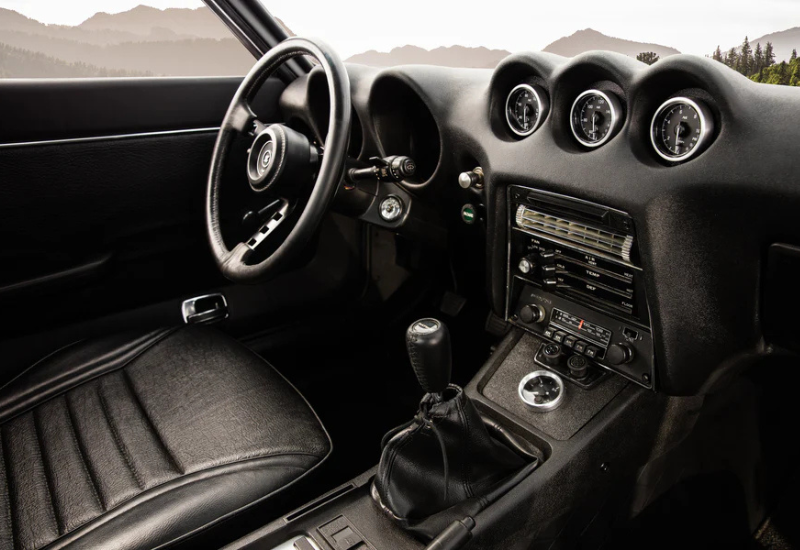
Five gauges populated the interior, arranged in two zones. Behind the steering wheel, a large tachometer sat on the left, reading to 8,000 rpm with a yellow caution zone beginning at 6,500 rpm and a red line starting at 7,000 rpm. The speedometer occupied the right position, reading from 0 to 160 mph on later production cars (early cars started at 20 mph). Atop the center dashboard, positioned directly above the radio and climate controls, sat three additional secondary gauges: a combination water temperature and oil pressure gauge on the left, a fuel gauge in the center, and a clock on the right. This elevated positioning put the secondary information in the driver’s peripheral vision rather than requiring a downward glance.
Standard Equipment List
For a car at its price point, the standard equipment list reads remarkably long. The factory included:
- Genuine wood steering wheel rim (faux wood construction with authentic wood appearance)
- Genuine wood shift knob
- Reclining bucket seats for driver and passenger
- Console box between the seats
- Door armrests on both sides
- Driver’s footrest
- Locking glove box
- Pushbutton AM radio
- Clock
- Coat hangers
- Windshield and rear window drip moldings
- Front and rear bumper bars
- Steering lock
- Collapsible steering column (a safety feature rare at this price in 1970)
- 175×14 radial tires (standard rather than bias-ply, which was unusual for the segment)
- Backup lights
Optional Equipment
Air conditioning added $325 to the sticker price, and the pushbutton AM radio was technically an additional $59.95 option in some market documents, though many cars arrived equipped with it. The factory did not offer leather upholstery as a standard option. Seat material was vinyl, which proved both durable and appropriate for a sports car marketed for active use.
Specs and Models
Engine Variants
| Specification | 1970-1971 (US) | 1972 (US) | 1973 (US) | Japan Fairlady Z 432 |
|---|---|---|---|---|
| Engine | L24 SOHC I-6 | L24 SOHC I-6 | L24 SOHC I-6 | S20 DOHC I-6 |
| Displacement | 2,393 cc | 2,393 cc | 2,393 cc | 1,998 cc |
| Bore x Stroke | 83 x 73.7 mm | 83 x 73.7 mm | 83 x 73.7 mm | 82.0 x 62.8 mm |
| Compression | 9.0:1 | 8.8:1 | 8.8:1 | 10.0:1 |
| Power (US) | 151 bhp @ 5,600 rpm | 150 bhp @ 5,600 rpm | 150 bhp @ 5,600 rpm | 160 bhp @ 7,000 rpm |
| Torque (US) | 146 lb-ft @ 4,400 rpm | 145.7 lb-ft @ 4,400 rpm | 145.7 lb-ft @ 4,400 rpm | 108 lb-ft @ 5,600 rpm |
| Carburetors | 2x Hitachi SU-type | 2x Hitachi SU-type | 2x Hitachi/SU emissions-spec | 3x Mikuni-Solex |
| Transmission | 4-speed manual | 4-speed manual | 4-speed manual | 5-speed manual |
| Top Speed | ~125 mph | ~122 mph | ~122 mph | ~137 mph |
| 0-60 mph | ~8.0 seconds | ~8.3 seconds | ~8.5 seconds | ~7.8 seconds |
Generation and Model Comparison
| Model | Years (US) | Base Price | Wheelbase | Curb Weight | Production Total |
|---|---|---|---|---|---|
| 240Z | 1970-1973 | $3,526-$4,690 | 90.7 in | 2,238-2,302 lbs | ~168,000 worldwide |
| 260Z 2-seat | 1974 | ~$5,399 | 90.7 in | ~2,520 lbs | ~33,000 US |
| 260Z 2+2 | 1974-1975 | ~$5,680 | 102.6 in | ~2,680 lbs | Portion of above |
| 280Z 2-seat | 1975-1978 | ~$6,999 | 90.7 in | ~2,800 lbs | ~170,524 US |
| 280Z 2+2 | 1977-1978 | ~$8,500 | 102.6 in | ~2,980 lbs | Portion of above |
The Datsun 240Z Interior in Detail
Seats and Upholstery
The factory fitted full-width reclining bucket seats upholstered in vinyl. The seat design used a pleated center section with ventilation buttons, and the stitching pattern differed between early (1970-1971) and later (1972-1973) production cars. The 1972-1973 seat design gets its own upholstery kits from restoration suppliers because the pleat pattern and vent placement changed enough to make early kits non-interchangeable with late cars.
Standard interior color for most US-specification cars was black. The factory paired black interiors with nearly every exterior color, with beige and coffee-brown accent choices appearing in the color matrix for certain exterior shades. Orange (code 918), white (code 904), and silver (code 901) were the only exterior colors offered across the entire 1970-1973 production run without interruption. Other exterior colors shifted or changed for the 1972 model year, and their companion interior trims shifted accordingly.
The Steering Wheel and Shift Knob
The factory wood-rimmed steering wheel and wood shift knob stand as the interior’s most distinctive tactile details. Period testers consistently noted how the thin wooden wheel communicated road feel while still feeling premium. The shift knob screwed onto an M8 x 1.25 thread and sat at a height that naturally aligned with the driver’s elbow when the arm rested on the console. The gate itself used a narrowly spaced H-pattern, and drivers moving between second and third gear covered roughly five inches of lateral travel, a throw that felt deliberate and mechanical in a way that modern short-throw setups do not replicate.
Dashboard Layout and Console
The dashboard used a two-zone layout. The main instrument binnacle housed the speedometer and tachometer behind the steering column, angled slightly toward the driver. The raised secondary gauge pod mounted to the top center of the dashboard, giving the three smaller gauges a panoramic sightline from almost any seating position. Below this pod, the factory placed the pushbutton AM radio and the heating/ventilation controls in a center stack arrangement.
The floor console ran between the seats and housed the shift lever, the emergency brake handle, and additional storage under the lidded console box. The choke control mounted directly to the center console as a pullout paddle, requiring the driver to set it manually before cold starts. This process became a ritual that regular owners described as part of the car’s character rather than an inconvenience.
Heating and Ventilation
The factory HVAC system delivered fresh air through dash vents and defrost ducts, with a multi-speed blower and separate temperature control. Air conditioning added a separate set of vents integrated into the dash. The 1971 factory service supplement covered the HVAC system in dedicated sections, indicating that Nissan treated climate control as a priority for the American market rather than an afterthought.
What It Is Like to Drive
Settling into the 240Z requires a brief moment of orientation. The bucket seat positions the driver low relative to the cowl, and the large steering wheel sits at an angle that feels more continental European than Japanese. The wood rim is thinner than modern wheels, which puts more of the driver’s palm in direct contact with its circumference rather than wrapping around a thick foam grip.
Starting the engine from cold means pulling the choke paddle on the console partway out, then depressing the clutch and checking neutral before turning the key. The 2.4-liter inline-six fires quickly and idles high until the water temperature gauge needle climbs to the “T” in the “TEMP” marking on the dial. This process takes roughly two to three minutes on a cold morning and costs nothing in modern convenience because the payoff arrives the moment the choke goes back in and the throttle response sharpens.
Owning One Today
What to Inspect Before Buying
Rust represents the primary structural enemy of every 240Z. The frame rails, floor pans, rear quarter panel lower sections, and the area around the spare tire well all collect moisture and corrode from the inside out. A buyer who skips a thorough underbody inspection on any candidate car will eventually find expensive surprises after purchase. Panel replacements for heavily corroded sections run $2,000 to $5,000 depending on severity and the fabricator’s shop rate.
Beyond rust, the datsun 240z interior itself presents specific restoration challenges. Original dashboards crack along the top surface with age, and correct replacement top caps exist for 1970-1972 cars but require sourcing from specialty suppliers. The original gauge faces fade and yellow; replacement faces in both black and white are commercially available. The original printed circuit boards behind the gauges corrode and cause intermittent electrical behavior, and the factory voltage-regulated cluster uses resistance values from original sending units that do not match modern replacement senders without adaptation.
Parts Availability
The 240Z benefits from a dedicated and well-organized parts ecosystem. Structural components like floor pans and frame rails exist as reproduction items. Weatherstripping, door seals, window rubbers, and glass seals are reproduced to factory specifications. The original push-button radio style repeaters, interior trim screws, and even the correct horn pad insert retaining clips exist as reproduction or NOS items through Z-specific suppliers.
Sourcing factory-correct parts for a numbers-matching restoration costs significantly more than ordering functional replacements, but both paths remain viable. The community surrounding these cars actively cross-references factory service bulletins and color code documents to verify correct specifications, which helps buyers and restorers confirm authenticity.
Market and Values
Current Market Values by Condition
| Condition Grade | Description | Typical Price Range (USD, 2025-2026) |
|---|---|---|
| #1 Concours | Perfect, show-quality, correct in all details | $80,000-$315,000+ |
| #2 Excellent | Numbers-matching, fully restored, driver quality | $45,000-$80,000 |
| #3 Good | Solid driver, minor cosmetic issues, mechanically sound | $20,000-$45,000 |
| #4 Fair | Running, needs work, some rust, drivable | $10,000-$20,000 |
| #5 Project | Non-running or heavily rusted, parts car or long-term build | $5,000-$10,000 |
Ownership and Maintenance Cost Estimates
| Service Category | Estimated Cost Range | Notes |
|---|---|---|
| Full engine rebuild (L24) | $3,500-$6,500 | Including parts and labor |
| Transmission overhaul | $1,500-$3,000 | Complete service or replacement |
| Panel rust repair | $2,000-$5,000 | Per affected area |
| Quality paint job | $3,000-$7,000 | Includes prep and rust treatment |
| Chrome trim restoration | $1,000-$2,500 | Bumpers and trim |
| Interior re-upholstery (both seats) | $400-$1,500 | Vinyl to full leather |
| Carpet kit replacement | $200-$500 | With correct padding |
| Dashboard cap (original-style) | $150-$350 | Reproduction available |
| Suspension refresh (full) | $500-$1,500 | Springs, shocks, bushings |
| Complete frame-off restoration | $30,000-$60,000 | Professional shop, all-in |
The 240Z market has moved sharply upward over the past decade. A mint-condition 1971 example crossed $315,000 at auction, representing the ceiling of what the market currently produces for the rarest and cleanest examples. Average auction results for 1972 models sit between $28,000 and $36,000. The record auction price for a 1973 model reached $77,000 at Mecum Monterey in August 2024. The lowest recorded sale for a project-grade 1971 car came in at $5,850 as recently as July 2025, confirming that the market still accommodates entry-level buyers willing to do the work themselves.
FAQ
What gauges does the Datsun 240Z have from the factory?
The factory installed five gauges across two dashboard zones. The primary binnacle behind the steering wheel holds a tachometer on the left, reading 0-8,000 rpm with a yellow caution zone at 6,500 rpm and a red line at 7,000 rpm, and a speedometer on the right, reading to 160 mph. Atop the center dashboard, three smaller secondary gauges cover the combination water temperature and oil pressure reading (one gauge), a fuel level gauge, and a clock. Early 1970 speedometers started their scale at 20 mph rather than 0, which Nissan corrected on later production cars. All five instruments use a dark matte face with white markings and chrome bezels.
What materials did Datsun use for the 240Z seats?
Datsun upholstered the factory seats in black vinyl as the primary material for US-market cars. The seat design incorporated a pleated center section with ventilation buttons along the seams and used a different pleat pattern for 1970-1971 cars versus 1972-1973 cars, making the upholstery kits model-year specific. Seat foam was a conventional urethane construction that hardens and compresses over time. The factory did not offer a leather seat option from the production line, though the aftermarket provides correct-pattern leather replacements today. Seat backs reclined manually, and adjustment mechanisms on surviving cars often require lubrication or replacement after fifty years of use.
How much does a correct interior restoration cost on a 240Z?
A full interior restoration on a 240Z running from seats through carpet, dashboard, gauges, and trim typically runs $3,000 to $8,000 at a professional shop using period-correct materials. The cost range spreads widely based on condition of the existing components. Seats alone run $400 to $1,500 for re-foam and re-upholstery depending on shop rates and material choice. A replacement carpet kit with proper padding runs $200 to $500. Dashboard restoration including a new top cap and gauge face refresh adds another $300 to $700. Owners who do the work themselves can cut these figures significantly, as most components require mechanical aptitude rather than specialized tooling.
What colors were available for the 240Z interior?
US-specification 240Z cars primarily used black interiors. The factory color matrix paired black interiors with most exterior colors and offered beige and coffee-brown accent variations for certain exterior paint codes. Interior color choices were not as extensive as the exterior palette, which included orange (code 918), white (code 904), silver (code 901), several blues, reds, and metallic options. Only three exterior colors ran across the entire 1970-1973 production without interruption: orange, white, and silver. The others shifted or changed at the 1972 model year breakpoint, and factory service bulletins document exactly which interior color combinations matched each exterior paint code by production date.
What are the biggest interior problems to watch for when buying a 240Z?
Dashboard cracking along the top surface ranks as the most visually prominent issue, and the vinyl dries out and splits in climates with strong UV exposure or extreme temperature cycling. Original gauge printed circuit boards corrode at the contact points, causing partial or complete gauge failure. Seat foam collapses inside the upholstery, making the seats feel flat and providing less lateral support than the factory design intended. The console box lid and its hinges crack with age. Weatherstripping around the doors and hatch deteriorates, allowing water intrusion that then damages the carpet and eventually the floor pans below it. Checking for water stains on the carpet and softness in the floor pans under the rubber padding tells you immediately whether water has been entering the cabin.
Is the 240Z interior comfortable enough for long drives?
The 240Z performs well on drives of two to four hours for most adults of average build. The reclining bucket seats provide reasonable support for highway cruising, and the low seating position combined with the large greenhouse delivers good sightlines. Taller drivers above 6’2″ find headroom tighter than they would like, particularly with the original seat foam in compressed condition. Road and wind noise levels at highway speeds exceed what modern cars produce at the same speed, which fatigues some drivers over long distances. The HVAC system moves adequate air volume for most climates without air conditioning, but humid summer driving in hot regions makes the optional air conditioning a genuine quality-of-life addition rather than a luxury. The driving position itself rewards long miles because the wheel, shifter, and pedals align naturally without the compromised ergonomics that many small sports cars of the era imposed.
Conclusion
The Datsun 240Z interior accomplished something rare: it made a $3,526 car feel like a serious driver’s machine without faking it. Five dedicated gauges, a wood shift knob, a wood-rimmed steering wheel, and reclining bucket seats created a cockpit that matched the car’s mechanical capabilities. The layout aged well because it started from an honest premise: put every control where the driver needs it, measure what matters, and build it well enough to last.
Today, a survivor-quality example commands $45,000 to $80,000 at auction, and a perfect concours car has crossed $315,000. The interior restoration market supports every level of rebuild, from factory-correct concours restorations using correctly pleated vinyl to full leather upgrades with modern gauge systems. Parts availability remains strong across the specialist supplier network, and factory service documents provide the reference material needed to verify correct specifications.
The datsun 240z interior holds its value precisely because it was never about luxury. It was about intention. Every element the factory included served a purpose, and that clarity of purpose is exactly what collectors, drivers, and restorers continue to respond to more than fifty years after the first cars reached American showrooms.