

What Is Freon in a Car and How Does It Work?

If your car’s AC stopped blowing cold air, someone probably told you the car needs freon. That’s the word most drivers use, even though it technically hasn’t applied to cars made after 1995. Freon is a brand name, DuPont’s trademarked term for R-12 refrigerant, and it works the same way tissue paper got called Kleenex. The name stuck. Today, when a shop says your car needs freon, they mean it needs refrigerant, and the type depends entirely on how old your vehicle is.
Understanding what refrigerant actually does, when your car needs it, and who handles it saves you money and prevents you from getting oversold on services you don’t need. For drivers looking for reliable automotive information, understanding how modern vehicle systems work is essential. This guide covers the full picture: the history of freon in cars, what replaced it, what the current refrigerant costs, who checks and adds it, and what every owner should watch for.
A Brief History of Freon in Cars
Where It All Started
Car air conditioning showed up commercially in 1940, when Packard became the first automaker to offer factory AC as an option. The refrigerant those early systems used was R-12, sold under the DuPont brand name Freon. R-12 is a chlorofluorocarbon (CFC), meaning its chemical structure includes chlorine, fluorine, and carbon atoms. It worked well, it was affordable, and for about 50 years it dominated automotive cooling.
The problem with R-12 came to light in the 1970s, when researchers F. Sherwood Rowland and Mario J. Molina published findings showing that CFC compounds break down in the stratosphere when exposed to ultraviolet radiation. The chlorine atoms split off and attack ozone molecules, destroying them in substantial quantities. R-12 carries a global warming potential (GWP) of 10,200, meaning it traps atmospheric heat at 10,200 times the rate of carbon dioxide. The science alarmed regulators, and in 1987 the Montreal Protocol established a global phase-out schedule for CFC refrigerants. The United States fully banned R-12 production for automotive use in 1996.
The R-134a Era
Automakers needed a replacement fast, and by the mid-1990s R-134a became the new standard. R-134a is a hydrofluorocarbon (HFC): it contains fluorine and hydrogen, but no chlorine, so it doesn’t damage the ozone layer. Automakers rolled it out starting in 1994, and by 1996 every new car in the US ran on R-134a.
R-134a held the top spot for about 30 years. It’s non-flammable, widely available, inexpensive at roughly $10 to $20 per pound, and familiar to every shop in the country. The issue that eventually forced a second transition wasn’t ozone damage. R-134a has a GWP of 1,430, meaning it still traps heat at 1,430 times the rate of CO2. Environmental regulators called that unacceptably high.
R-1234yf Takes Over
The EPA mandated that all new vehicles produced in the US starting in 2021 switch from R-134a to a lower-GWP alternative. Most manufacturers complied by adopting R-1234yf, a hydrofluoroolefin (HFO) refrigerant developed jointly by Honeywell and Chemours (the former DuPont chemical division). R-1234yf carries a GWP of just 4, compared to R-134a’s 1,430. It also breaks down in the atmosphere in approximately 11 to 12 days, versus R-134a’s 13-year atmospheric lifespan.
Some manufacturers started making the switch earlier. General Motors began putting R-1234yf in select Chevrolet and Cadillac models around 2014 to 2015. By 2025, every new light vehicle from the factory uses R-1234yf. The transition doesn’t strand R-134a owners immediately. That refrigerant stays in service for existing vehicles and remains available for recharge, though the EPA established a production phase-down schedule: 60 percent of baseline production in 2024, 30 percent by 2029, and an 85 percent reduction by 2036. Prices will rise gradually as availability shrinks.
How Freon Actually Works in Your Car
The Cooling Cycle
Your car’s AC system runs refrigerant through a closed loop continuously. It never burns the refrigerant or consumes it. A properly sealed system keeps the same charge for years. Here’s what happens every time you hit the AC button:
The compressor, driven by the engine via a serpentine belt, pressurizes the refrigerant gas into a hot, high-pressure state. That hot gas flows into the condenser, a component positioned in front of the radiator that looks like a small radiator itself. Air flowing through the condenser pulls heat out of the refrigerant, cooling it down and converting it from gas to liquid.
The liquid refrigerant then passes through an expansion valve or orifice tube, which drops the pressure rapidly. That pressure drop cools the liquid dramatically, down to around 32 degrees Fahrenheit. The cold refrigerant enters the evaporator, a small heat exchanger located behind your dashboard. Your blower fan pushes cabin air across the evaporator’s fins, the refrigerant absorbs the heat from that air, and the now-cooled air flows through your vents. As the refrigerant absorbs heat, it evaporates back into a gas and returns to the compressor to begin the cycle again.
The system also pulls moisture out of the cabin air as a side effect. That puddle of water you see under a parked car on a hot day comes from condensation draining off the evaporator. Completely normal.
Why Systems Lose Refrigerant
A healthy closed AC system doesn’t consume refrigerant. If the level drops, something is leaking. Leaks develop at O-ring seals, hose connections, the compressor shaft seal, or through microscopic perforations in aging hoses. Low refrigerant doesn’t cause itself. It signals an underlying problem that needs fixing before a recharge makes sense. Shops that top off a leaking system without finding the source just put refrigerant in something that will be empty again in a few months.
What Replaced Freon in Cars
| Refrigerant | Years in Use | GWP | Atmospheric Lifespan | Flammability | Cost Per Pound |
|---|---|---|---|---|---|
| R-12 (Freon) | 1940-1996 | 10,200 | 100 years | None | Rare, hard to source |
| R-134a | 1994-present (legacy) | 1,430 | 13 years | Non-flammable (A1) | $10-$20 |
| R-1234yf | 2014-present | 4 | 11-12 days | Mildly flammable (A2L) | $70-$120 |
R-1234yf delivers 95 to 99 percent of R-134a’s cooling efficiency, according to SAE testing. The cooling difference isn’t noticeable in practice. The differences that do matter are price and service requirements. R-1234yf requires separate, specialized equipment that shops must purchase specifically for it. The service couplers use a different size than R-134a systems, and the hose connections use a left-handed thread, making accidental cross-contamination physically impossible. Shops must also own R-1234yf-specific gauges to check system pressure accurately.
The mildly flammable classification (ASHRAE A2L) doesn’t mean the refrigerant poses a serious fire hazard in a car. Extensive real-world testing across millions of vehicles hasn’t produced hazardous results. The classification simply requires technicians to follow specific handling protocols.
Signs Your Car Needs a Freon Check
What to Watch For
Low refrigerant doesn’t announce itself with a dashboard light. You catch it by paying attention to how the AC performs.
- AC blows warm or mildly cool air instead of cold
- The compressor clutch doesn’t engage when you turn on the AC (you normally hear a click when it engages)
- AC only cools while driving at speed, but not at idle
- The system cycles on and off rapidly without maintaining consistent cooling
- Windows fog up slowly or won’t clear on defrost
- Ice forming on AC lines or components (evaporator icing due to low pressure)
- A greasy, oily residue near AC connections, hoses, or the compressor
A greasy residue around AC components almost always means a leak. Refrigerant carries compressor oil through the system, so when refrigerant leaks out, it leaves an oily film at the leak point. Catching this early prevents the compressor from running dry of oil, which can destroy it. Compressor replacement runs $500 to $1,500 in parts and labor, far more than a leak repair and recharge.
When Warm Air Doesn’t Mean Low Refrigerant
Warm air from the vents doesn’t automatically mean the freon is low. A faulty compressor clutch, broken blend door actuator, clogged cabin air filter, failed pressure switch, or electrical problem in the AC controls can all cause the same symptom. A proper AC diagnosis costs $25 to $50 at most shops and checks system pressures, compressor engagement, and visible components before anyone touches the refrigerant. Skipping diagnosis and going straight to a recharge is a waste of money if the underlying problem is something else.
Specs by Refrigerant Type and Vehicle
| Vehicle Age | Refrigerant Type | Typical Charge Volume | Recharge Cost (Independent Shop) | Recharge Cost (Dealer) |
|---|---|---|---|---|
| Pre-1994 | R-12 | 32-48 oz | Specialty only; rare | N/A for most dealers |
| 1994-2015 (approx) | R-134a | 16-32 oz | $100-$200 | $150-$300 |
| 2014-2021 (transition) | R-134a or R-1234yf | 14-24 oz | $100-$250 | $200-$400 |
| 2021-present | R-1234yf | 10-20 oz | $150-$300 | $250-$500 |
| Large SUVs / dual AC | R-134a or R-1234yf | 32-48+ oz | $150-$350 | $275-$500+ |
Charge volumes and costs vary by make and model. Check the under-hood AC label for your car’s exact refrigerant type and specified charge weight in ounces or grams.
Who Checks and Adds Freon in Cars
Professional Service Options
Any shop with EPA Section 609 certification can legally service automotive AC systems. Federal law requires this certification for anyone who handles automotive refrigerants professionally. You can’t just hand your car to any technician. The shop needs to hold the certification and use EPA-compliant recovery equipment to capture old refrigerant rather than venting it.
Here’s who offers AC service and what to expect:
Independent auto repair shops: The best value for most drivers. Independent specialists with the right equipment handle both R-134a and R-1234yf systems, often at 20 to 30 percent lower cost than dealers for the same work. Find a shop with ASE-certified technicians and confirm they service your refrigerant type before booking.
National chains: Jiffy Lube, Firestone Complete Auto Care, Pep Boys, Midas, and Meineke all offer AC recharge services. Jiffy Lube performs a visual inspection of the compressor drive belt, serpentine belt, and accessible components before evacuating and recharging. Firestone includes pressure and temperature testing as part of the service. Costs at national chains typically run $100 to $200 for R-134a and $150 to $300 for R-1234yf, though individual franchise pricing varies. Check the chain’s website for location-specific coupons before you go.
Dealerships: Highest labor rates, most familiar with your specific vehicle’s systems, and required for warranty-related AC work. Expect $150 to $300 for R-134a service and $250 to $500 for R-1234yf. Worth choosing if your car is under warranty or if the problem requires diagnosis of a complex, model-specific fault.
AutoZone and O’Reilly Auto Parts: These stores sell DIY recharge kits and refrigerant cans. They don’t perform AC service themselves, but they stock the supplies if you want to handle a simple R-134a top-off. R-1234yf DIY kits are now available as well but involve more complexity.
DIY: What You Can and Can’t Do
A basic R-134a DIY recharge kit costs $20 to $50 and connects to the low-side service port in your engine bay. This works if you have a slow leak and simply want to top off the charge temporarily, but it doesn’t find or fix the leak. You also can’t properly evacuate the old refrigerant with a DIY kit. Professional machines recover the old charge before adding new refrigerant, which matters for system integrity.
For R-1234yf systems, DIY is technically possible with kits now available at AutoZone and Walmart for around $45 to $50 per 8-ounce can. However, the EPA requires a leakdown test before recharging R-1234yf systems. You can’t legally recharge a leaking R-1234yf system without repairing it first. The specialized connections prevent cross-contamination, but the process is more involved and worth leaving to a shop for most drivers.
Federal law prohibits venting refrigerant intentionally. Shops must recover it with certified equipment.
Do They Still Use Freon in Cars?
The short answer: no, not technically. Freon (R-12) hasn’t appeared in new cars since 1996. Do they still use refrigerant in cars? Absolutely. Every car with AC uses it. Most vehicles on the road today run R-134a, and every car manufactured in 2021 or later uses R-1234yf.
Classic car owners with pre-1996 vehicles face the most complicated situation. R-12 production stopped entirely in the US years ago. Remaining supplies trade on the collector market and at specialty shops for high prices. Many classic car owners convert their systems to run R-134a instead, which requires replacing seals, oil, and the receiver-drier, and typically costs $300 to $600 at a specialist who handles vintage cars.
Ownership and Maintenance Cost Table
| Service Type | R-134a Cost | R-1234yf Cost | Notes |
|---|---|---|---|
| System inspection / leak check | $25-$50 | $30-$75 | Pressure test, visual check |
| Evacuation and recharge (independent) | $100-$200 | $150-$300 | Full service with recovery |
| Evacuation and recharge (dealer) | $150-$300 | $250-$500 | Higher labor rate |
| Leak detection (UV dye or electronic) | $50-$100 | $75-$150 | Needed before recharge |
| Simple leak repair (O-ring/seal) | $100-$250 | $100-$300 | + recharge cost |
| Compressor replacement (if damaged) | $600-$1,500 | $700-$1,800 | Avoid by catching leaks early |
| DIY recharge kit | $20-$50 | $45-$100 | R-134a only recommended for DIY |
| Classic car R-12 to R-134a conversion | $300-$600 | N/A | One-time system retrofit |
FAQ
Who puts freon in cars, and do they need special certification?
Any shop with EPA Section 609 certification handles automotive refrigerant legally. This covers most auto repair chains, dealerships, and independent shops equipped with recovery machines. The certification exists because refrigerant handling requires proper equipment to avoid releasing it into the atmosphere. Both federal law and environmental regulations prohibit venting. You can take your car to any Jiffy Lube, Firestone, Midas, Pep Boys, or independent shop that lists AC service and holds the certification. If you’re unsure, ask the shop directly whether they’re Section 609 certified and whether they service your specific refrigerant type (R-134a or R-1234yf), since not every shop has invested in R-1234yf-specific equipment yet.
What replaced freon in cars, and does the new refrigerant work as well?
R-12 (Freon) gave way to R-134a in the mid-1990s, and R-134a is now transitioning out in favor of R-1234yf. R-1234yf delivers 95 to 99 percent of R-134a’s cooling efficiency according to SAE testing, so the real-world difference is imperceptible to drivers. The key change is environmental: R-1234yf has a global warming potential of just 4 compared to R-134a’s 1,430, and it breaks down in the atmosphere within 11 to 12 days versus R-134a’s 13-year persistence. The main downside is cost. R-1234yf runs $70 to $120 per pound at retail, compared to $10 to $20 per pound for R-134a, which makes recharge service noticeably more expensive on newer vehicles.
Who checks freon in cars, and how does the process work?
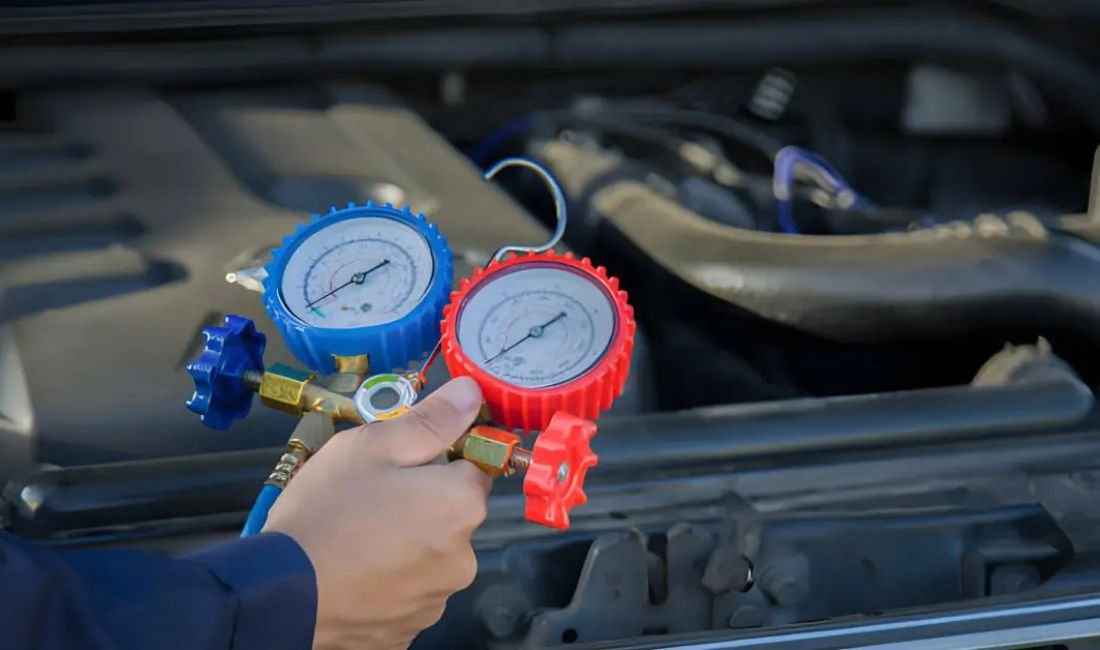
A technician uses a manifold gauge set to measure both the high-pressure and low-pressure sides of the AC system. Normal operating pressures vary by refrigerant type and ambient temperature, but a low-side reading below about 25 psi and a high-side reading below about 150 psi typically indicate a low charge. The technician also checks for leak indicators: oily residue, refrigerant dye under UV light, or an electronic sniffer that detects refrigerant vapor in the air around components. Basic system inspection costs $25 to $50 at most shops. Some shops include a quick visual inspection and pressure check at no charge as part of an AC service quote.
Do they still use freon in cars, and what happens if you have an older car?
No car manufactured after 1995 uses R-12 Freon. Vehicles made between 1994 and roughly 2015-2018 use R-134a, and 2021 and newer vehicles all use R-1234yf. If you drive a pre-1994 vehicle with original R-12, sourcing refrigerant is difficult and expensive because production stopped decades ago. Most mechanics recommend converting the system to R-134a, which requires new seals, O-rings, and a receiver-drier replacement, typically $300 to $600 at a shop that handles classic vehicles. If your system still has its original R-12 charge and runs well, preserve it carefully, because every ounce that escapes is gone and expensive to replace.
What are the best places that put freon in cars, and how do you choose one?
National chains like Firestone Complete Auto Care, Pep Boys, Midas, and Jiffy Lube all offer AC recharge services at consistent pricing. Independent shops often cost 20 to 30 percent less for the same work and may provide more thorough diagnosis. Dealerships charge the most but handle warranty-related issues and complex model-specific diagnostics best. For straightforward recharges on common vehicles, an independent shop or national chain works well. For R-1234yf vehicles (2017 and newer, approximately), confirm the shop owns the specialized equipment before booking. Not every shop has invested in R-1234yf service machines, which cost significantly more than R-134a equipment. The under-hood AC label lists your refrigerant type and exact charge weight; bring that information when you call shops to confirm compatibility.
How often does a car need a freon recharge, and is it routine maintenance?
A properly sealed AC system doesn’t need regular recharging. Unlike oil, refrigerant doesn’t degrade or get consumed in normal operation. If your system loses refrigerant, something is leaking. That’s a repair problem, not a maintenance interval. Some very slow leaks through aging seals cause gradual performance loss over several years, and a recharge every five to eight years can restore cooling on older vehicles. But a shop that recommends annual or biannual recharging as routine maintenance is selling you something you don’t need unless a leak diagnosis confirms the system actually lost charge. If you notice the AC getting gradually weaker over months, that’s a legitimate sign to have it checked.
Conclusion
The word freon in cars has outlived the actual product by decades. R-12 Freon left the automotive world in 1996, but the name stayed because it was already part of how drivers talked about car AC. Today, freon in cars means whatever refrigerant your specific system uses: R-134a for most vehicles still on the road, R-1234yf for anything made in 2021 or later, and R-12 only for pre-1994 classics that haven’t been converted.
Understanding the difference matters when you talk to a shop. Knowing that R-1234yf costs three to five times more per pound than R-134a explains why an AC recharge on a newer car runs $200 to $300 instead of $100. Knowing that a properly sealed system never needs refrigerant helps you push back when a shop recommends routine recharges without evidence of a leak. And knowing that warm air from vents has multiple possible causes, not just low refrigerant, means you start with a $25 to $50 diagnosis before anyone adds anything.
The AC system in your car runs a sealed loop that, under normal conditions, should hold its charge for the life of the vehicle. When it doesn’t, you have a leak. Find the leak, fix it, then recharge. That sequence keeps the system running right and keeps your money where it belongs.