
Ferrari F40 Flat Bottom Steering Wheel

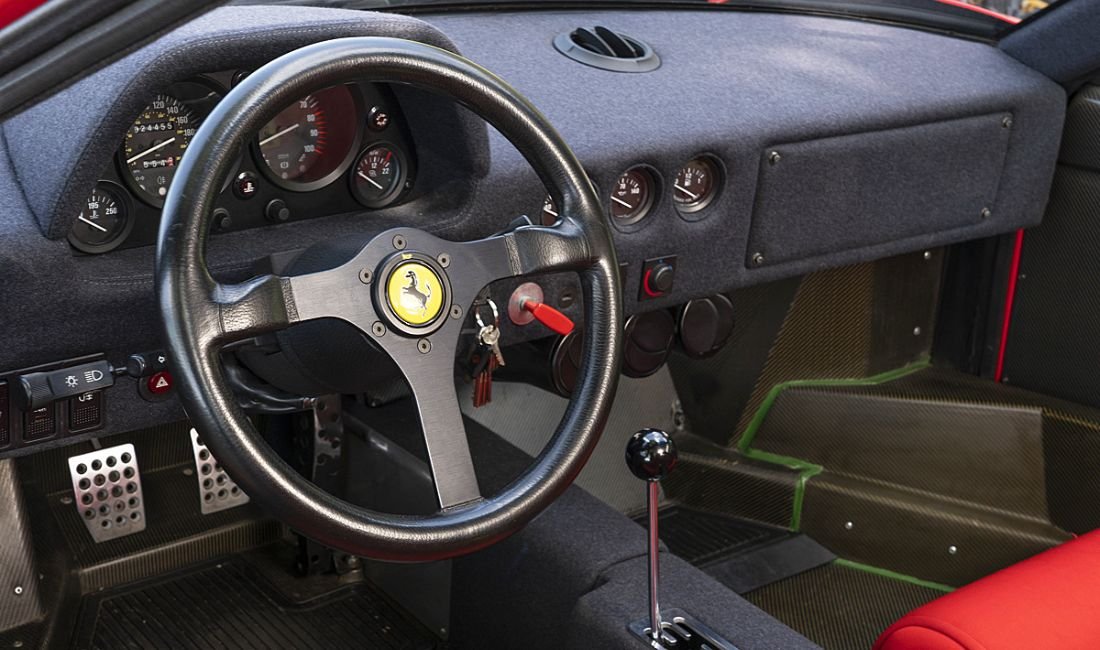
The Ferrari F40 sits in a category of its own. Ferrari built exactly 1,311 examples between 1987 and 1992, plus a handful of racing variants that ran through 1996, and every single one put the driver face-to-face with a cockpit that communicated one thing without ambiguity: this is a racing car that happens to be road-legal. At the center of that cockpit sat a MOMO-supplied steering wheel, 350mm in diameter, three-spoked, and trimmed in black leather, functioning as the primary physical connection between the driver and an unassisted, raw, completely analog machine. That wheel, and its more aggressive flat-bottom variant found in the racing versions, tells you almost everything you need to know about what Ferrari was going for with this car.
Chief engineer Nicola Materazzi and Enzo Ferrari wanted no ambiguity in the driving experience. The F40 shed every concession to comfort: no carpet, no door handles, no radio, no leather trim, no glove box. What it kept was a purposeful, functional interior derived almost directly from the 288 GTO Evoluzione race car, with anti-glare felt on the dashboard, white-on-black Veglia gauges, rocker switches, and that MOMO wheel sitting at the center of it all. Understanding the steering wheel means understanding the philosophy behind the entire car.
A Brief History
Ferrari presented the F40 to the press on July 21, 1987, at the Civic Centre in Maranello, not at Frankfurt as originally planned. Fiat needed the Frankfurt show for the Alfa Romeo 164 launch, so Enzo pushed Ferrari’s own event earlier. The name came directly from Ferrari’s 40th anniversary, and Enzo made it his final public appearance at the unveiling, wearing his signature dark glasses. He died the following year in August 1988.
The F40 grew out of the 288 GTO Evoluzione, a race-development project that never saw proper competition. Materazzi received permission from Enzo to hand-pick his engineering team and was given just eleven months to develop the car from the starting date of June 10, 1986. Ferrari’s initial production target was 400 units. Demand from customers was so intense that production stretched to 1,311 road cars, with an additional small number of racing variants built alongside and after the main production run.
The MOMO Relationship
MOMO’s relationship with Ferrari goes back to 1964, when racing driver Gianpiero Moretti commissioned a craftsman to build him a custom steering wheel for his race car. That wheel caught the attention of Ferrari Formula One driver John Surtees, who fitted it to his car and won the 1964 Formula One world championship in it. Ferrari and MOMO have maintained a close technical collaboration ever since, which is why the F40 road car received a MOMO unit as standard equipment.
Key Generations
The F40 program produced five distinct variants over its production life, each with its own steering wheel and cockpit setup.
Road Car (1987–1992)
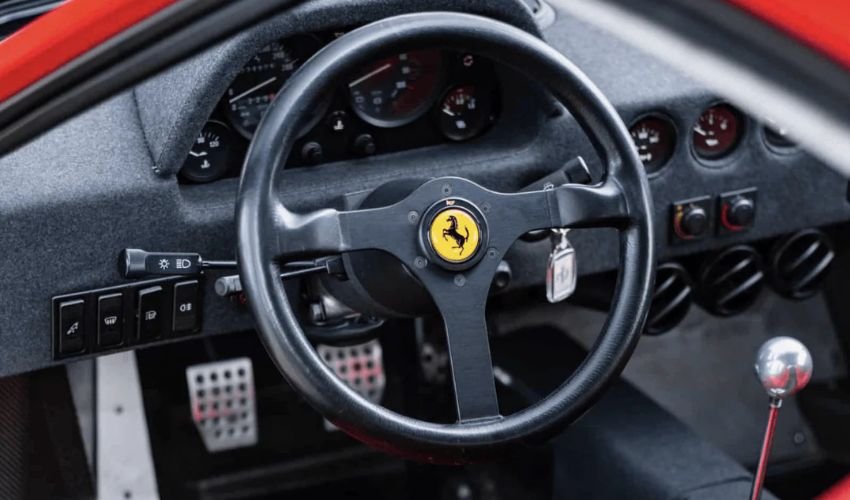
The standard road car used a round-rim MOMO wheel in 350mm diameter, trimmed in black leather, with three spokes and a central Ferrari prancing horse horn button. The dish was flat (zero dish), giving it a clean, purposeful look without any decorative curves. This wheel had no controls on it, no paddle shifters, and no airbag, consistent with the entirely stripped-back interior philosophy. The cockpit derived from the 288 GTO Evoluzione, with a fabric-covered dash designed to eliminate glare.
F40 LM (1989–1994)
French importer Charles Pozzi commissioned the LM variant for the Le Mans competition two years after the road car’s debut. Michelotto Engineering converted 19 cars to LM specification, with 27 more private-team conversions following. The LM replaced the pop-up headlights with single, large fixed units from 1990 onward. Crucially, the LM received racing-spec MOMO steering wheels, available in either red or black, both carrying the Ferrari logo in the center. The flat-bottom design appeared here as a practical racing tool to give the driver faster thigh clearance when getting in and out of the car and more accurate leg positioning when driving. The LM’s engine displaced 3.0 liters and produced significantly more power than the road car.
F40 Competizione (1989)
Ferrari built 10 Competizione examples after the first two LMs were completed. The cars were meant for clients who wanted LM-spec machinery but not necessarily for Le Mans-specific racing. The name change from LM to Competizione came because Ferrari felt the Le Mans tag was too restrictive for what was essentially becoming a collector’s item with racing capability. The Competizione retained the flat-bottom racing MOMO wheel setup from the LM.
F40 GT (1993)
Michelotto converted seven F40 road cars to GT specification for the Italian GT Championship. The GT produced 560 bhp from the standard 2.9-liter engine and ran 17-inch magnesium wheels, upgraded brakes, a racing exhaust, and improved cooling. The F40 GT debuted in the 1993 Italian Supercar Championship, and the driver Vittorio Colombo won the 1994 season in it.
F40 GTE (1995–1997)
The GTE was the most extreme racing variant, built for GT1-class competition in the BPR Global GT Series and Le Mans. Seven examples existed, one converted from an LM, one from an F40 GT, and five from road cars. The GTE produced 620 bhp from a 3.0-liter engine in 1994, growing to 3.5 liters in 1995 and 3.6 liters by 1996-1997. The GTE offered three steering wheel options: two MOMO designs in red or black with the Ferrari logo, or a black OMP unit without any Ferrari branding.
What Made It Different
The F40 arrived in 1987 when every other supercar manufacturer was moving toward electronics, driver aids, and luxury. Porsche had just unveiled the computer-controlled 959. Lamborghini was developing sophisticated successors to the Countach. Ferrari itself had been nudging the Testarossa in a more grand-touring direction. The F40 rejected all of that and went the opposite direction.
The body, fabricated by Scaglietti, used Kevlar, carbon fiber, and aluminum panels bonded over a tubular steel spaceframe reinforced with carbon-fiber inserts. Ferrari did not use a full carbon monocoque at this stage, which came with the F50 in 1995, but the F40 was still the first series production car in the world whose body was constructed almost entirely of composite materials. Weight came in at 1,254 kg in European specification, versus 1,369 kg for the US version with its required catalytic converter and emissions equipment.
The steering required no power assistance. The five-speed gearbox had no synchromesh assists beyond the driver’s own input. There was no ABS, no traction control, no stability management of any kind. The brakes were 330mm ventilated discs with four-piston Brembo calipers, and stopping required meaningful pedal pressure. The flat-bottom MOMO wheel on the racing variants was not a styling choice but a functional one, giving drivers in full harness the ability to enter and exit the car faster and position their legs more accurately during driving.
The standard road car wheel, while round rather than flat-bottomed, sat in the same philosophy. It was small at 350mm, unadorned, leather-covered, and entirely focused on giving the driver a feel through the unassisted rack. Every input the driver made translated directly to the front wheels without electronic mediation.
Specs and Models
Engine Variants and Specifications
| Variant | Engine | Displacement | Power | Torque | Weight |
|---|---|---|---|---|---|
| Road Car (EU) | Tipo F120A twin-turbo V8 | 2,936 cc | 478 PS (471 hp) | 577 Nm (426 lb-ft) | 1,254 kg |
| Road Car (US) | Tipo F120D twin-turbo V8 | 2,936 cc | 484 PS (477 hp) | 577 Nm (426 lb-ft) | 1,369 kg |
| F40 GT | Modified V8 twin-turbo | 2,936 cc | 560 bhp | N/A | Reduced |
| F40 LM/Competizione | Racing V8 twin-turbo | 2,936 cc | 691 hp | 713 Nm | 1,040 kg |
| F40 GTE (1994) | Racing V8 twin-turbo | 3,000 cc | 620 bhp | N/A | ~1,000 kg |
| F40 GTE (1995–97) | Racing V8 twin-turbo | 3,500–3,600 cc | 620+ bhp | N/A | ~1,000 kg |
Additional technical details for the road car: – Bore x Stroke: 81.9 mm x 69.5 mm – Compression: 7.7:1 – Turbochargers: Twin IHI water-cooled units, 1.1 bar boost – Intercoolers: Twin Behr units – Fuel injection: Weber-Marelli IAW combined ignition/fuel injection – Lubrication: Dry sump – Valvetrain: DOHC, four valves per cylinder – Wheels: 17-inch Speedline two-piece alloys – Tyres: Pirelli P Zero (specifically developed for the F40) – Front tyres: 245/40 ZR17 – Rear tyres: 335/35 ZR17 – Drag coefficient: Cd 0.34 – Top speed: 201 mph (324 km/h) – 0–100 km/h: 3.5 seconds (launching at redline)
Generation and Model Comparison
| Model | Years | Units Built | Steering Wheel | Headlights | Engine Size |
|---|---|---|---|---|---|
| Road Car | 1987–1992 | 1,311 | Round MOMO leather, 350mm | Pop-up | 2.9L |
| F40 LM | 1989–1994 | 46 total (19 Michelotto + 27 private) | Flat-bottom MOMO red/black | Fixed (from 1990) | 3.0L |
| F40 Competizione | 1989 | 10 | Flat-bottom MOMO | Covered | 3.0L |
| F40 GT | 1993 | 7 | Racing MOMO | Pop-up | 2.9L |
| F40 GTE | 1995–1997 | 7 | MOMO red/black or OMP black | Fixed | 3.0–3.6L |
What It Is Like to Drive
The F40 sits just 1,124 mm tall, and getting in means lowering yourself into a reclined bucket seat with no door handle, just a fabric strap. Raw carbon fiber lines the doors, and rearward visibility goes through louvred engine slats.
The MOMO wheel dominates the foreground. Behind it sit Veglia gauges for speed, revs, water temp, and crucially, turbo boost pressure, because the twin IHI turbos need active monitoring.
Cold starts require waiting for the turbocharger oil circulation before touching the throttle. The engine idles with a clattery mechanical din that sounds wrong but isn’t. Below 4,500 rpm, the car feels manageable. Then the boost arrives, and zero to 200 km/h disappears in under 12 seconds. First-time passengers consistently respond with profanity.
The unassisted steering communicates exactly what the front tires are doing at all times. Turn-in is sharp. At high speeds, chassis behavior becomes a conversation entirely between the driver and the road. Any vibration or instability the car communicates through the wheel demands immediate attention, because there are no electronics to mask or buffer what the tyres are telling you. The rear requires respect: getting on the power too early in a corner causes the rear to step out, and getting off the power too early causes understeer. The car rewards smooth, precise inputs and punishes aggressive or clumsy ones. There is no safety net in electronics. The flat-bottom steering wheel on the racing cars made all of this slightly easier to manage by improving the driver’s seating position and thigh clearance, reducing fatigue on long stints.
Owning One Today
The F40 is not a car you buy and ignore. Ferrari produced a total of 1,311 road cars, and every one of them is now over 30 years old. The rubber safety fuel cells in each car had a factory-specified ten-year lifespan, meaning every car on the road today needs to have had those replaced or at minimum inspected by specialists. The timing belts require regular attention, and the twin IHI turbochargers, while robust, need properly warmed-up oil before they see boost.
The steering wheel is an area where originality matters significantly. The factory-correct MOMO unit with the Ferrari horn button is essential for a fully matching car. Reproductions exist and meet 2015 homologation standards, but collectors paying $2 million-plus for a correctly documented example want the original part number 133888 intact and functional.
Finding qualified mechanics is a genuine challenge. The F40 is not a car where a general-purpose independent Ferrari specialist will necessarily have deep knowledge. The turbocharger setup, the dry-sump lubrication, the Kevlar and carbon-fiber body panels, and the early Weber-Marelli fuel injection all require familiarity that only comes from working on these specific cars regularly.
Ferrari did not fit ABS or traction control to the F40, which means insurance and storage decisions carry more weight than they would with a modern machine. Most owners drive these cars carefully and rarely, which creates its own problem: Ferraris that sit unused develop seal deterioration, battery issues, tire flat-spotting, and fuel system problems. Regular use within reasonable limits is healthier for the car than long-term storage.
Market and Values
The F40 market peaked in 2022 when pristine examples achieved $3.5 to $4.0 million at major auction houses. The market moderated through 2023 and 2024 before stabilizing. The most recent public sale on record, a 1992 example at Mecum Kissimmee in January 2026, sold for $5,830,000, setting a new high. The average auction sale price across all recorded transactions stands at $2,831,873.
Market Values by Condition
| Condition | Description | Price Range (USD, 2025–2026) |
|---|---|---|
| Concours / Show Quality | Under 1,000 km, matching numbers, original steering wheel, full books | $3.5M–$5.8M+ |
| Excellent | 5,000–15,000 km, full service history, original components, correct color | $2.2M–$2.8M |
| Very Good | 15,000–25,000 km, well-maintained, most original parts, some period upgrades | $1.8M–$2.2M |
| Good / Driver | 25,000+ km, service history with gaps, possible non-original items | $1.4M–$1.8M |
| Project / Parts | Significant issues, missing documentation, or accident history | Below $1.0M |
Mileage matters less than documentation and originality. A well-documented 20,000 km car with full service history consistently outsells a low-mileage car with unexplained gaps in its records. Color affects value: Rosso Corsa is the reference color and commands premiums, while unusual or non-factory colors sell at discounts. The original MOMO steering wheel with the Ferrari horn button is specifically cited in auction lot descriptions as a significant originality point.
Between 2014 and 2024, average F40 prices tripled from roughly $1.1 million to $3.2 million. Fixed supply of 1,311 cars against a growing pool of ultra-high-net-worth collectors means the structural case for continued appreciation remains strong.
Ownership and Maintenance Costs
| Cost Category | Annual Estimate (USD) | Notes |
|---|---|---|
| Annual inspection and fluids | $3,000–$6,000 | Specialist labor essential |
| Major service (timing belts, full inspection) | $8,000–$15,000 | Every 3–4 years recommended |
| Turbocharger inspection / rebuild | $5,000–$12,000 per unit | Condition dependent |
| Fuel cell inspection/replacement | $8,000–$20,000 | Original cells rated 10 years |
| Insurance (agreed value policy) | $12,000–$25,000/year | Depends on location and use |
| Storage (climate controlled) | $3,000–$8,000/year | Essential for long-term condition |
| Replacement steering wheel (MOMO replica) | $300–$600 | Original OEM: significantly higher |
| Tires (Pirelli P Zero F40 fitment) | $4,000–$7,000/set | Rear 335/35 ZR17 sourcing variable |
FAQ
What steering wheel did the Ferrari F40 road car use?
The road car came fitted with a MOMO-supplied three-spoke steering wheel in 350mm diameter with a black leather rim and a central Ferrari prancing horse horn button. The dish was flat at 0mm, meaning the face of the wheel sat on a single plane without the convex curve found in many period steering wheels. The unit had no integrated controls, no airbag, and no paddle shifters. It connected directly to an unassisted steering rack, meaning the driver felt everything through the wheel.
What is the difference between the road car wheel and the flat-bottom racing wheel?
The road car used a round-rim MOMO, where the grip follows a traditional circular cross-section path all the way around. The flat-bottom wheel on the LM, Competizione, and GTE racing variants had the bottom section of the rim removed or flattened, which served two practical functions: it gave the driver more thigh clearance during entry and exit when wearing a helmet and harness in a tightly packaged racing cockpit, and it allowed more precise leg and hip positioning relative to the pedal box during driving. The racing versions of the F40 used either red or black MOMO flat-bottom wheels with the Ferrari logo in the center, or, in some configurations, a black OMP wheel without any Ferrari branding.
How many Ferrari F40s were built, and how does that affect value?
Ferrari produced 1,311 road cars, 213 of which were delivered to the US market. Racing variants add to the total: approximately 46 F40 LMs including private conversions, 10 Competiziones, 7 F40 GTs, and 7 GTEs, bringing the full production figure across all variants to roughly 1,311 per Ferrari’s official total. That fixed supply number, which will never increase, set against growing collector demand has driven the market. The most recent auction sale in January 2026 achieved $5,830,000.
Does the F40 have any driver aids?
No. The F40 has no ABS, no traction control, no stability management, and no power steering. The car was a deliberate rejection of the electronic trend that every competitor was embracing in the late 1980s. Ferrari’s intent was to produce the most direct, communicative driving experience possible. The MOMO steering wheel connects mechanically and without assistance to the front wheels. Braking, cornering balance, and throttle management all rest entirely with the driver’s hands and feet.
What makes the F40 cockpit unusual compared to other supercars of its era?
The cockpit came directly from the 288 GTO Evoluzione race car. The dashboard used anti-glare felt fabric instead of leather or plastic. There were no door panels, exposing the carbon-fiber inner structure. The seats were lightweight bucket units with blue fabric upholstery and no adjustment beyond basic positioning. A pair of rubber safety fuel cells sat against the rear bulkhead, visible from inside. The Veglia instruments in the main binnacle included a turbo boost gauge, an unusual sight in a road car at the time but essential for monitoring the twin IHI turbocharger system. The total effect was of sitting in a racing car that had been made minimally roadworthy, which was precisely the intention.
Is the F40 difficult to drive on public roads?
Honest answer: yes. The turbo lag means that below approximately 4,500 rpm, the car feels manageable, but the transition to full boost requires anticipation and positioning within a corner rather than reactive inputs. The unassisted steering is heavy at parking speeds. Rear visibility is limited through the louvred engine cover. The car is 4,430 mm long with 335mm rear tyres, making spatial awareness a real requirement. Experienced drivers who understand how to manage the boost threshold and who treat the car with respect find it deeply rewarding. Drivers who expect modern supercar accessibility will find the F40 genuinely demanding.
Conclusion
The Ferrari F40 flat-bottom steering wheel is not a styling choice. It is a piece of equipment designed for a specific purpose: putting a driver in close physical contact with an unmediated racing machine in the most functional position possible. On the road car, the round MOMO communicates everything through the unassisted rack. On the racing variants, the flat-bottom version solves real cockpit access and driving position problems that matter at Le Mans or the Nürburgring.
The car around that wheel remains one of the most coherent engineering statements in the history of road cars. Everything in the F40, from the composite body that Ferrari describes as the first series production car built almost entirely of composite materials, to the twin IHI turbochargers, to the bare carbon-fiber interior surfaces, serves the same goal: maximum performance with minimum mass and maximum driver involvement. Enzo Ferrari personally approved this car before his death in 1988. It was built in eleven months. It broke the 200 mph barrier as the first production car to do so. And in January 2026, one sold for $5,830,000.
That steering wheel, small, leather-wrapped, and entirely analog, sat at the center of all of it.