
Iconic Vehicles: The Complete Story of the Ford Mustang

Introduction
The Ford Mustang arrived at the 1964 New York World’s Fair on April 17th, priced at $2,368, and broke every sales forecast Ford had ever written. Executives had projected 100,000 units in the first year. On the first day alone, dealers took 22,000 orders. Within 12 months, Ford had moved 417,000 Mustangs off lots across America, a production record that stood unchallenged for decades.
What made that launch so extraordinary was not just the numbers. Ford built the Mustang on humble Falcon and Fairlane components to keep costs low, yet the car looked like nothing the mass market had ever seen. The long hood, short deck, and three body styles from launch gave buyers a sense of exclusivity at a price any working American could reach. Before the Mustang, you either bought performance or you bought affordability. Ford argued you could have both.
Sixty years on, the Mustang sits in its seventh generation and remains the last traditional American muscle car still in full production. The Chevrolet Camaro and Dodge Challenger are both discontinued. Over 10 million Mustangs have been sold worldwide since 1964, and the nameplate now stretches from a $35,000 daily driver to a $325,000 track weapon that lapped the Nurburgring in 6 minutes and 52 seconds. That range alone tells you more about what the Mustang actually is than any single sentence could.
A Brief History
The first generation ran from 1964 through 1973 and produced some of the most desirable variants in American automotive history: the Shelby GT350 and GT500, the Boss 302, and the Boss 429. The Boss 429 in particular exists because NASCAR required manufacturers to sell at least 500 street-legal cars with any engine they wanted to race. Ford’s 429-cubic-inch V8 was too large to fit a standard Mustang without structural modification, so Ford contracted Kar Kraft in Michigan to cut and weld each car individually. Only 1,356 Boss 429s were ever built across 1969 and 1970, making them the crown jewel of the entire generation.
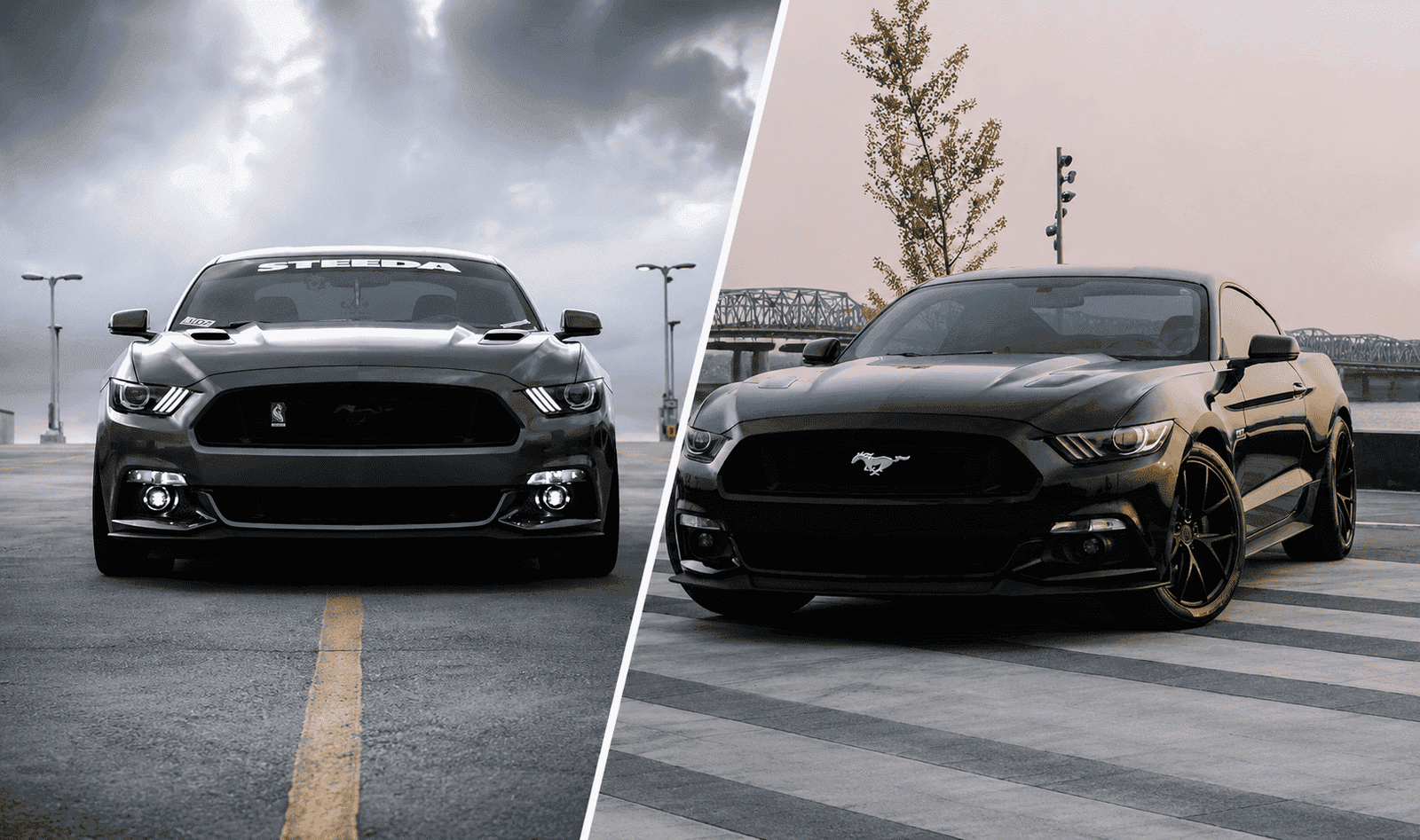
The second-generation Mustang II (1974 to 1978) arrived during the oil crisis and drew criticism for its smaller, less powerful character. Sales peaked at 385,000 units in 1979 with the third-generation Fox Body, which ran until 1993 and became the foundation for some of the most modified and raced Mustangs in history. The fourth generation SN95 (1994 to 2004) modernized the platform, and the fifth generation S197 (2005 to 2014) brought back the retro muscle car look that resonated globally. The sixth-generation S550 (2015 to 2023) added independent rear suspension to replace the solid rear axle for the first time, a change that fundamentally improved how the car handles. The seventh and current generation S650 launched in 2024 with a digital interior overhaul and a new top model, the GTD, that changes the conversation about what a Mustang can be.
Key Generations
First Generation (1964 to 1973): The Blueprint
Ford introduced the pony car segment with this generation and sold more than 2.4 million units across its nine-year run. The 1966 model year alone moved 607,000 cars, the highest single-year total in Mustang history. Engine options ranged from a 170-cubic-inch inline-six producing 101 horsepower to the K-code High Performance 289 V8 rated at 271 horsepower, and the lineup grew dramatically from there. The 428 Cobra Jet arrived in 1968, followed by the semi-hemi Boss 429 in 1969. By the end of this generation, the Mustang had grown heavier and larger, a trend that contributed to the radical rethink that followed.
Second Generation Mustang II (1974 to 1978): The Difficult Years
Built on a Pinto platform to meet new emissions and fuel economy requirements, the Mustang II divided opinion then and still does. Ford sold 385,993 units in the first model year, which proved buyers accepted the direction even if enthusiasts resisted it. The high-performance GT option disappeared entirely. A 302 V8 returned in 1975, but in severely detuned form, producing just 122 horsepower. This generation is rarely collected for its performance but remains historically significant as evidence that Ford would compromise the formula rather than kill the nameplate.
Third Generation Fox Body (1979 to 1993): The Enthusiast’s Favorite
Ford rebuilt the Mustang on the Fox platform it shared with the Fairmont, giving the car a more modern unibody architecture and a dramatic weight reduction. The 5.0-liter High Output V8 returned in 1982 and grew into a cult engine, eventually producing 225 horsepower in stock trim and far more with modifications. The Fox Body became the aftermarket’s favorite canvas, with a parts catalog so extensive it still grows today. The 1993 Cobra and the SVT Cobra R remain the most sought-after examples from this generation.
Fourth Generation SN95 (1994 to 2004): Finding Modern Ground
Ford gave the Mustang a new body and platform while retaining the Fox Body’s basic architecture, a decision that drew some criticism but kept costs manageable. The SVT Cobra arrived in 1993 and carried into this generation with a hand-built 4.6-liter DOHC V8 rated at 305 horsepower. A 2003 Cobra with the Eaton supercharger produced 390 horsepower and 390 lb-ft of torque, the most powerful production Mustang built up to that point. The 2003 and 2004 Cobras are now appreciating significantly on the collector market.
Fifth Generation S197 (2005 to 2014): The Global Mustang
Ford made a deliberate aesthetic decision to reference the 1964 Mustang’s proportions with the S197, and the strategy worked. Global sales expanded meaningfully as buyers in Europe and Australia embraced the retro design. The 2012 Boss 302 brought a flat-plane crankshaft V8 producing 444 horsepower and genuine track credentials. The 2013 Shelby GT500 topped out at 662 horsepower from a 5.8-liter supercharged V8, making it the most powerful production car Ford had ever built at the time.
Sixth Generation S550 (2015 to 2023): Independent Rear Suspension at Last
After 50 years of solid rear axles, Ford switched to independent rear suspension for the S550, a change that transformed the car’s behavior on anything other than a drag strip. The GT350 (2016 to 2020) used a flat-plane crank 5.2-liter V8 that spun to 8,250 rpm and produced 526 naturally aspirated horsepower, a genuinely exotic specification for a car starting below $60,000. The GT500 returned in 2020 with a supercharged 5.2-liter Predator V8 making 760 horsepower. Both cars established the S550 as the most performance-credible Mustang since the original muscle car era.
Seventh Generation S650 (2024 to Present): Digital Era
The S650 arrived for 2024 with a redesigned exterior and a fully digital interior featuring a 12.4-inch driver display and a 13.2-inch touchscreen. The platform evolved from the S550 rather than being replaced, but the changes in driving dynamics and technology are substantial. The 2025 Mustang GTD, developed alongside the GT3 endurance racing program, produces 815 horsepower from a supercharged 5.2-liter Predator V8 with a rear transaxle layout. It lapped the Nurburgring in 6:52.072 in May 2025, making it the fastest American production car to complete the circuit at that time.
What Made It Different
The Mustang created the pony car segment, which means it created an entirely new category of vehicle. Before April 1964, no manufacturer offered a sporty, affordable, extensively customizable coupe to the mass market. Buyers could configure the original Mustang as an economical commuter or a legitimate performance machine from the same base price. Ford’s option list at launch was staggering: two body styles, multiple engine choices, transmission options, and visual packages that made each car feel individual. Sports cars from that era, including the Datsun 240Z with its minimalist interior philosophy, targeted a far narrower and more expensive audience.
No other performance car has sold to as many different types of buyers. The Mustang works as a daily driver, a weekend track car, a show vehicle, a restomod project, a concours restoration, and a serious collector investment depending on the model and the year. That breadth of appeal is not an accident. Ford designed it deliberately, and 60 years of continuous production prove the strategy works.
The cultural footprint also separates the Mustang from every other vehicle in its class. It appeared in major films starting in 1964, became the pace car at the 1964 Indianapolis 500 within weeks of launch, and generated a global enthusiast community that supports a parts and accessories industry worth hundreds of millions of dollars annually. The Camaro and Challenger both died. The Mustang survived by evolving while keeping the shape and the name recognizable across every generation.
Specs and Models
Engine Variants by Generation
| Engine | Displacement | Output | Years Available |
|---|---|---|---|
| Inline-6 (base) | 2.8L / 3.3L | 101–120 hp | 1964–1983 |
| Hi-Po K-Code 289 V8 | 4.7L | 271 hp | 1964–1967 |
| 428 Cobra Jet V8 | 7.0L | 335 hp (underrated) | 1968–1970 |
| Boss 302 V8 | 4.9L | 290 hp | 1969–1970 |
| Boss 429 V8 | 7.0L | 375 hp | 1969–1970 |
| 5.0L Fox Body HO V8 | 5.0L | 225 hp | 1982–1993 |
| 4.6L DOHC SVT Cobra V8 | 4.6L | 305–390 hp | 1996–2004 |
| 5.0L Coyote V8 | 5.0L | 412–486 hp | 2011–present |
| 5.2L Flat-Plane GT350 V8 | 5.2L | 526 hp | 2016–2020 |
| 5.2L Supercharged Predator V8 | 5.2L | 760 hp (GT500) | 2020–2022 |
| 2.3L EcoBoost I4 Turbo | 2.3L | 310–315 hp | 2015–present |
| 5.2L Supercharged Predator GTD V8 | 5.2L | 815 hp | 2025–present |
Current Lineup Specs (2026 Model Year)
| Model | Engine | Output | 0–60 mph | Starting MSRP |
|---|---|---|---|---|
| EcoBoost | 2.3L Turbo I4 | 315 hp / 350 lb-ft | ~5.1 sec | ~$35,000 |
| GT | 5.0L Coyote V8 | 486 hp / 418 lb-ft | ~4.1 sec | ~$45,000 |
| Dark Horse | 5.0L Coyote V8 | 500 hp / 418 lb-ft | ~3.9 sec | ~$60,000 |
| GTD | 5.2L Supercharged V8 | 815 hp / 664 lb-ft | ~3.0 sec | ~$325,000 |
Generation and Model Comparison
| Generation | Years | Platform | Key Change | Notable Model |
|---|---|---|---|---|
| 1st Gen | 1964–1973 | Falcon-derived | Created pony car segment | Boss 429, Shelby GT500 |
| 2nd Gen (Mustang II) | 1974–1978 | Pinto-derived | Downsized for fuel crisis | Cobra II |
| 3rd Gen (Fox Body) | 1979–1993 | Fox unibody | Modern architecture | 1993 SVT Cobra R |
| 4th Gen (SN95) | 1994–2004 | Fox-derived | Restyled, modern safety | 2003 SVT Cobra |
| 5th Gen (S197) | 2005–2014 | New platform | Retro design, global sales | GT350, GT500 (662 hp) |
| 6th Gen (S550) | 2015–2023 | New multilink IRS | Independent rear suspension | GT350, GT500 (760 hp) |
| 7th Gen (S650) | 2024–present | Evolved S550 | Digital interior, GTD flagship | GTD (815 hp) |
What It Is Like to Drive
The Mustang GT with the manual transmission is one of the most honest cars you can buy. The 5.0-liter Coyote V8 makes a sound at 6,000 rpm that manufacturers with three times the budget cannot replicate artificially, and it pulls hard from just above idle. Compared to the Camaro, which has always had stiffer, more sports car-oriented suspension, the Mustang feels more pliable and natural on public roads. That is not a compromise; it is a deliberate tuning choice that makes the car easier to enjoy without full concentration.
The Dark Horse sharpens everything. The 500-horsepower Coyote in that car breathes through a revised intake, revs harder, and comes with MagneRide adaptive dampers that manage the tradeoff between ride comfort and cornering control better than any previous naturally aspirated Mustang. The Tremec six-speed manual transmission has a mechanical, precise action that rewards drivers who rev-match on downshifts. It drives smaller than its dimensions, which is the same observation journalists made comparing it to the Challenger a decade ago. One thing drivers notice immediately at highway speeds is how planted the S650 feels; if you have ever dealt with steering wheel vibration at high speeds in older performance cars, the S650’s refined chassis and improved geometry largely eliminate that issue from the factory.
The GTD lives in a different category entirely. With 815 horsepower, a rear transaxle for near-perfect weight distribution, and adaptive aerodynamics, it set a 6:52.072 lap time at the Nurburgring in May 2025 piloted by factory driver Dirk Muller. That puts it in the same conversation as Porsche 911 GT variants and AMG Black Series cars. Ford priced it around $325,000 and allocated units by application only.
Owning One Today
What to Buy and What to Avoid
The 2015 to 2023 S550 generation is the sweet spot for most buyers. The independent rear suspension made a real-world difference, the Coyote V8 is proven and parts-plentiful, and used examples have depreciated enough to make the value case compelling. Specifically, the 2018 and later models corrected early EcoBoost turbo lag issues and resolved an electrical wiring recall that affected 2015 and early 2016 production.
Avoid 2011 and 2012 models if you prefer simplicity. The first-generation Coyote engine in those years showed high oil consumption in some units, consuming up to a quart every 1,500 miles, and the electric power steering system introduced in 2012 had assist failure issues in early production runs. Both problems are well-documented and manageable if you find a car that has been maintained properly, but they add cost and complexity.
Pros of Ownership
- Largest aftermarket parts catalog of any American performance car
- 5.0L Coyote V8 routinely exceeds 150,000 miles with standard maintenance
- Strong resale value on GT and above models, especially manual transmission cars
- Ford dealer network in almost every market globally
- An active enthusiast community with technical expertise available for virtually any repair
Cons of Ownership
- Interior materials quality on base and mid-grade trims lags European competitors
- Rear visibility is poor; checking bodywork for parking damage requires care
- Non-engine electrical issues (infotainment, backup camera) are the most common reported complaints on 2015 to 2023 models
- RepairPal gives the Mustang a reliability score of 3.5 out of 5 with an average annual repair cost of $709, above the segment average
- V8 models in GT and above specifications require premium fuel, and keeping the air conditioning system properly charged adds to annual running costs on higher-mileage examples
- Buyers who cross-shop with Japanese alternatives should read a Lexus reliability comparison to understand the tradeoffs between character and long-term dependability
Classic Mustang owners have one additional consideration that modern buyers do not: transportation logistics. If you buy a non-running or show-condition car, understanding classic car towing requirements before you pull the trigger on a purchase saves you from expensive mistakes on collection day.
Market and Values
Market Values by Condition
| Vehicle | Poor Condition | Fair Condition | Good Condition | Excellent / Concours |
|---|---|---|---|---|
| 1964 Mustang Hardtop | $10,000–$15,000 | $20,000–$28,000 | $35,000–$50,000 | $55,000–$80,000+ |
| 1969 Boss 429 | $80,000–$120,000 | $150,000–$220,000 | $280,000–$400,000 | $500,000–$660,000+ |
| 1967 Shelby GT500 | $60,000–$90,000 | $100,000–$133,000 | $175,000–$250,000 | $300,000+ |
| 2020–2022 GT500 (S550) | $65,000–$80,000 | $85,000–$100,000 | $100,000–$130,000 | $140,000+ |
| 2024–2025 Mustang GT | $30,000–$36,000 | $37,000–$43,000 | $44,000–$50,000 | N/A (new) |
| 2025 Mustang GTD | — | — | $300,000–$360,000 | N/A (limited) |
The classic Mustang market trades actively and has seen consistent appreciation over the past decade. The Boss 429 set a recorded high of $660,000 in May 2026 for a 1970 example. A 1967 Shelby GT500 sold at auction in Spain for €133,000. First-generation standard Mustangs in good condition average around $28,000 for the 1964 model, though the range across body styles and engine codes is wide. The 1966 GT350 in Wimbledon White with blue stripes, particularly original-paint examples, trades well above $100,000 for driver-quality cars.
Ownership and Maintenance Costs (Modern Mustang)
| Cost Category | Annual Estimate | 5-Year Total |
|---|---|---|
| Scheduled Maintenance | $508 | $2,540 |
| Insurance (average, GT) | $2,655 | $13,275 |
| Fuel (V8 GT, mixed driving) | ~$3,200 | ~$16,000 |
| Depreciation (from new) | Varies | ~57% over 5 years |
| Unscheduled Repairs | ~$200–$700 | ~$1,500–$3,500 |
| Total Estimated 5-Year Cost | — | ~$62,776 |
The Mustang depreciates approximately 57% over five years from new, which makes two and three-year-old GT examples particularly attractive used buys. A 2023 Mustang GT that stickered at $48,000 new trades today for roughly $20,000 to $27,000 depending on mileage and condition. The EcoBoost model depreciates faster and in larger dollar terms, creating genuine value for used buyers who prefer the four-cylinder.
FAQ
Is the Ford Mustang a good daily driver?
Yes, and more so than most people assume before they own one. The EcoBoost model achieves 22 mpg in city driving and 33 mpg on the highway, making it affordable to run every day. The GT’s trunk measures 13.5 cubic feet, which handles groceries and weekend luggage without issue. Visibility rearward is limited, and the low seating position requires adjustment when coming from an SUV or crossover, but neither is a serious problem for experienced drivers. The 2015 and later S550 generation with independent rear suspension soaks up bad road surfaces far better than earlier solid-axle cars.
Which Mustang model year should I avoid when buying used?
The 2011 and 2012 models carry the most documented issues. Early Coyote V8 units in those years showed above-average oil consumption, and the 2012 introduction of electric power steering brought assist failure problems in some cars. The 2015 model year has two separate wiring routing recalls covering vehicles produced in early 2015 and again between May 2017 and June 2018. Buying any of these years is not a disaster if the car has a history, but you need to verify the recalls were addressed before committing. For the easiest ownership, 2018 and later S550 cars represent the most developed state of the generation.
How much does a Boss 429 cost today?
Authentic Boss 429 Mustangs trade between $150,000 and $660,000 depending on condition, documentation, and matching numbers. Ford only built 857 examples in 1969 and 499 in 1970, for a total production run of just 1,356 cars. The 7.0-liter 429 V8 was built to homologate Ford’s NASCAR engine, required structural modifications by Kar Kraft to fit the Mustang’s engine bay, and each car was assembled individually rather than on the standard production line. Unrestored, original-numbers cars with verifiable provenance command the highest prices. Cloned cars and converted Mach 1s exist in the market, so Marti Reports and VIN verification are essential before any purchase.
What is the difference between the Mustang GT and the Dark Horse?
Both use the 5.0-liter Coyote V8, but the Dark Horse produces 500 horsepower versus the GT’s 486 through a revised intake and a crankshaft and connecting rods sourced from the GT350. The Dark Horse also comes standard with MagneRide adaptive suspension, a Tremec six-speed manual with an upgraded cooling system, Brembo brakes, and unique aerodynamic elements including a functional rear wing. The interior gets Dark Horse-specific trim and a performance data recorder. On a track, the gap between the two cars is measurable. On the street, the Dark Horse costs roughly $15,000 more than a comparably optioned GT.
Is the Mustang GTD actually worth $325,000?
It depends entirely on what you compare it to. For that money, you can buy a Porsche 911 GT3, a base Ferrari, or several heavily modified Shelby GT500s. What you cannot buy for that money is another American production car that lapped the Nurburgring in 6:52. The GTD uses an 815-horsepower supercharged 5.2-liter Predator V8 with a rear transaxle for weight distribution, active aerodynamics, and adaptive suspension calibrated to racing-grade precision. Ford built it alongside the GT3 endurance racer and allocates units by application rather than on a first-come. Whether the badge justifies the price is a personal question, but the performance is objectively at the level of purpose-built European sports cars that cost considerably more.
How many Mustangs have been built in total?
Ford has sold more than 10.2 million Mustangs worldwide since the launch in April 1964. US domestic figures tracked officially show approximately 8.4 million units, with the remainder representing international exports, primarily to Europe and Australia, where right-hand drive models have been available since 2015. The best-selling single model year was 1966 at 607,000 units. The Mustang holds the record as the world’s best-selling sports coupe across multiple recent years and currently outsells every other traditional American muscle car, both of which are now discontinued. If you want to understand why Chevrolet struggled to keep the Camaro competitive over the same period, the gap in production volume and cultural momentum between the two cars tells most of the story.
Conclusion
The Ford Mustang has survived oil crises, fuel economy regulations, ownership changes inside Ford itself, two generations of fierce direct competition, and six decades of shifting consumer preferences. It did that by adapting its technology and powertrain in each generation while keeping the shape, the nameplate, and the rear-wheel-drive layout intact. No other American performance car has managed that continuity.
The range it covers today is genuinely extraordinary. A $35,000 EcoBoost coupe and an $815-horsepower Nurburgring-record GTD both wear the same badge and carry the same proportions. The classic market starts around $10,000 for a project car and reaches $660,000 for a verified Boss 429. Across that entire span, the Mustang remains the one American performance car that every driver recognizes regardless of age, country, or interest in cars. That is not luck or nostalgia. That is sixty years of getting the product right.